While growing up
on the range in the late 70's and early 80's, nearly
all of our drinking water came straight
from creeks, most of which had a healthy beaver population,
and all of which was in livestock grazing areas. Rarely
did we carry water bottles. We’d just lie on our
stomachs and drink like animals. Typically, we'd do
this upstream of where our sheep had crossed or drank
from earlier in the day...not due to fears of getting
sick but so the water wouldn't taste like a funky cross
between lanolin and shit. We did then what we are repeatedly
told not to do now... and we did it daily for months
at a time. Not only did we never get sick, it was not
even discussed as a possibility.
While these practices
are generally considered foolhardy today, they were
the norm for many ranchers and outdoorsmen of that era.
Of course, it wasn't much before those times that no
one treated their water. However, the infamous parasitic
Protozoan by the name of Giardia is said to be more
prevalent these days...though how much seems debatable.
There are a good number of accounts from people who
drink untreated backcountry surface water in the western
US and BC without issues. I personally know a half dozen.
One, who has practiced this rather indiscriminately
for thirty years, has had Giardia twice. The others
have not. In recent years, I have become more lax on
the use of filtering I took up in the early 90's, and
resumed drinking untreated water. Testing in 2014 has
shown no Giardia in my system...though I'm quite selective
as to where I drink (not downstream of human settlements,
grazing areas, etc). While one's immune system may affect
the outcome, it has been proven through water sampling
that Giardia is not as widespread as the water treatment
manufacturers would like consumers to believe…at
least in the Sierra Nevadas. Check out these two articles
here
and here.
Considering that, and from personal experience and that
of the others I mentioned, I suspect Giardia isn't an
issue in similarly remote areas either.
That said, I am not recommending
you test these suspicions and drink untreated water.
Depending on the location, there may be other contaminants
in the water besides Giardia. These might include bacteria,
viruses and believe it or not, chemicals. For those
reasons, I recommend that you treat your water. How
though is up to you based on the level of protection
you believe is needed. Below is
an overview of the most popular methods used by lightweight
travelers.
Bottle
filters
The bottle filter was one of the most clever inventions
to come out of the outdoor industry. It is simply a
water bottle with a replaceable filter cartridge under
the lid. To use, take off the lid/filter, dip the bottle
in the river, replace the lid/filter and squeeze/suck
for potable water (you'll frustrate/tire
quickly if you don't squeeze while sucking).
You can even do this while in the boat. Staying hydrated
has never been easier!
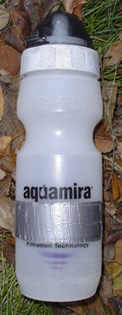 |
| Note
the duct tape on this bottle filter. I carry it
in several places including on person wrapped around
a lighter. |
No pumping, no extra water bottles
to carry, simple, always available, and only slightly
heavier than a conventional water bottle. The two drawbacks
is that they clog rather quickly in silty water and
require some effort, albeit little. For those who don't
mind a little squeezing, and will be filtering clear
water only, these bottles are tops for all-out convenience!
Most bottle filters
only take care of Protozoans and bacterias. If you're
worried about viruses and like the bottle
filter concept, make sure to get a purifying bottle
filter (Katadyn
makes the most popular). Just keep in mind that
purifying bottle filters use iodine and will leave your
water tasting as such (their carbon
filters only reduce the taste). Some can tolerate
this while others can not stomach it. If you want to
purify without imparting a nasty taste to the water,
you'll have to boil, filter with the First Need or MSR
Gaurdian (see below), or use
the Steripen. More on those methods below.
Also, though some bottle filters
may look identical to others, not all are equal in the
taste department. After using several, and before I
began using different methods of filtering, I came to
prefer the Aquamira...though
I did notice some taste inconsistencies in their filter
cartridges too. Changes in manufacturing, materials,
and suppliers can alter the tastes to any filter at
any time so you may have to experiment with different
brands if your taste buds are picky. However, to my
persnickety tongue, water never tastes "good"
coming from a plastic container. That said, these bottles
may also leach BPA or other undesireable chemicals into
your water. More on that towards the bottom of this
page.
Pump filters & purifiers
Filtering and purifying with hand held pump units are
the most common methods of water treatment. The two
types should not be confused though. While pump filters
(typically called microfilters)
and purifiers both have filter cartridges and are used
the same way, they do not provide equal amounts of protection.
A "filter" filters out sediment, protozoa
and bacteria while the "purifier" does that
plus destroys viruses.
Today, there are only two true pump
purifiers: The older First Need by
General Ecology and newer MSR
Gaurdian. With these two, what comes out after pumping
is filtered water that is unadultrated and purified.
No chemicals. The First Need is neither light nor compact.
The innovative MSR Gaurdian is heavier yet and, at $350,
expensive!
The MSR "Sweetwater Purifier
System" is simply a Sweetwater Mircofilter with
a chlorine-based solution you must physically add. One
can use any other filter in the same way. Though burdensome,
another way to get both filtered and purified water
is to use a regular filter then purify the filtered
water with a Steripen.
Filter or purifier, the one you
choose depends on the level of protection you believe
is needed. Most backcountry travelers in the western
US and British Columbia use a filter with no additional
viral protection (Katadyn
&
MSR
make a variety of pump fitlers). However, traveling
to different parts of the country or abroad may present
additional risks. You make the call.
| Chemicals
in backcountry water? How could that be? Believe
it or not, there are several ways chemicals
can end up in the backcountry water you are cooking
with & drinking. One route is via air masses
as noted below in No single raindrop believes
it is to blame for the flood. Other avenues
are herbicides used to kill poisonous plants in
campsites, various chemicals from upstream development
& ranching, fire retardants used in wildfires,
& remote
marijuana growing operations. |
It should also be noted that some
manufacturers claim their filters (including
some bottle filters) or purifiers "reduce"
"some" chemicals. Considering the options,
or lack of, this may offer a small piece of mind when
paddling where chemicals might be in the water. Yes,
one is probably far more likely to get struck by lightning
than have any sort of acute reaction from ingesting
chemicals in the backcountry. However, there are other
and far more complex issues associated with low dose
chemical exposures that are beyond the scope of this
page. For further reading, click here.
Tips:
- Always search for the cleanest
looking and slowest moving water you can find. The
faster the water is moving, the more particles there
will be suspended and the more you’ll unnecessarily
put in your filter or purifier's filter cartridge.
- Use a prefilter in muddy or
silty water. They can be backflushed in the field
and will keep your main filter cleaner longer.
- It’s a good idea to let
muddy or silty water settle several hours or overnight
before filtering/purifying. Instead of carrying
a special bucket for this, you can fill the stern
of an empty kayak and stand it upright against a
rock, tree, or steep bank. Do this as soon as you
get to camp so you can filter later that evening
and again the next morning.
My
top two choices for water treatment:
Katadyn
Pocket filter
for silty/turbid water & Sawyer
Mini filter for clear water.
(both shown below)
| Simple
& proven design capable of filtering the most
turbid water. Stainless steel & aluminum construction.
An easy & quick to clean ceramic cartridge that
can filter up to 13,000 gallons of water. Lifetime
guarantee. Meet the Swiss made Katadyn Pocket
filter, the most robust & reliable
backcountry filter money can buy! Comparatively
heavy & costly yes, but after yrs of trying
nearly every filter on the market, this is the only
one I have come to fully trust in silty water. One
does need to be careful not to drop the ceramic
cartridge while cleaning though. |
 |
|
|
The
Sawyer Mini is my filter of choice
for clear mountain water. It is the simplest,
lightest, & most versatile filter available.
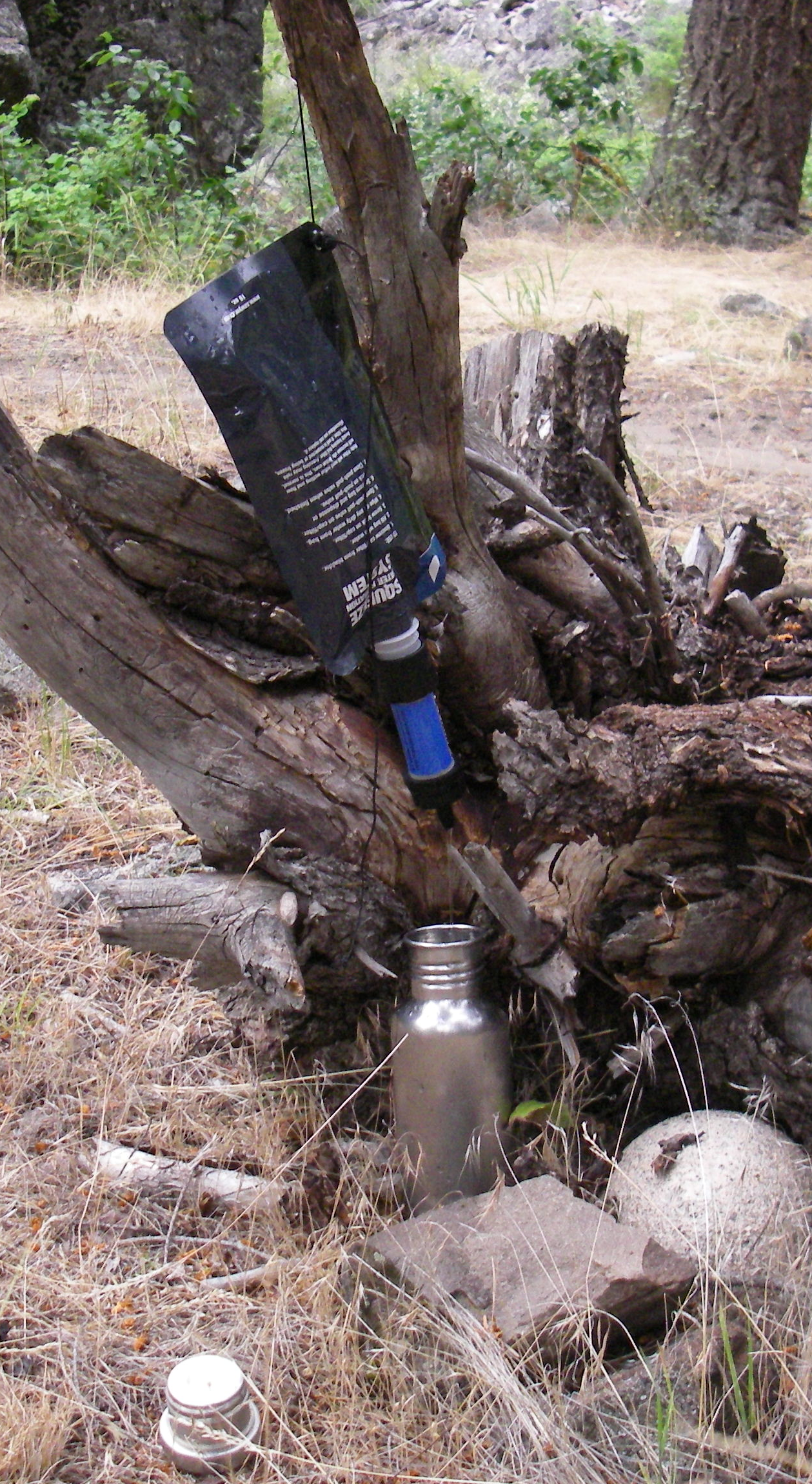
Put water in the bag, screw on filter, & squeeze
water into your bottle...or mouth. Or, as shown
in the pic to the left, hang it from something
(or lean), and let gravity do the work for you!
It'll fill a 27 oz bottle in ~5 minutes this way...&
the vulnerable bag will last many times longer
than if squeezing. It can also be used like a
straw, eliminating the need for a water bottle
and/or bag altogether. UPDATE:
The Katadyn BeFree is the new kid on the block
and preferred by most over the Sawyer Mini. I
have yet to try one.
|
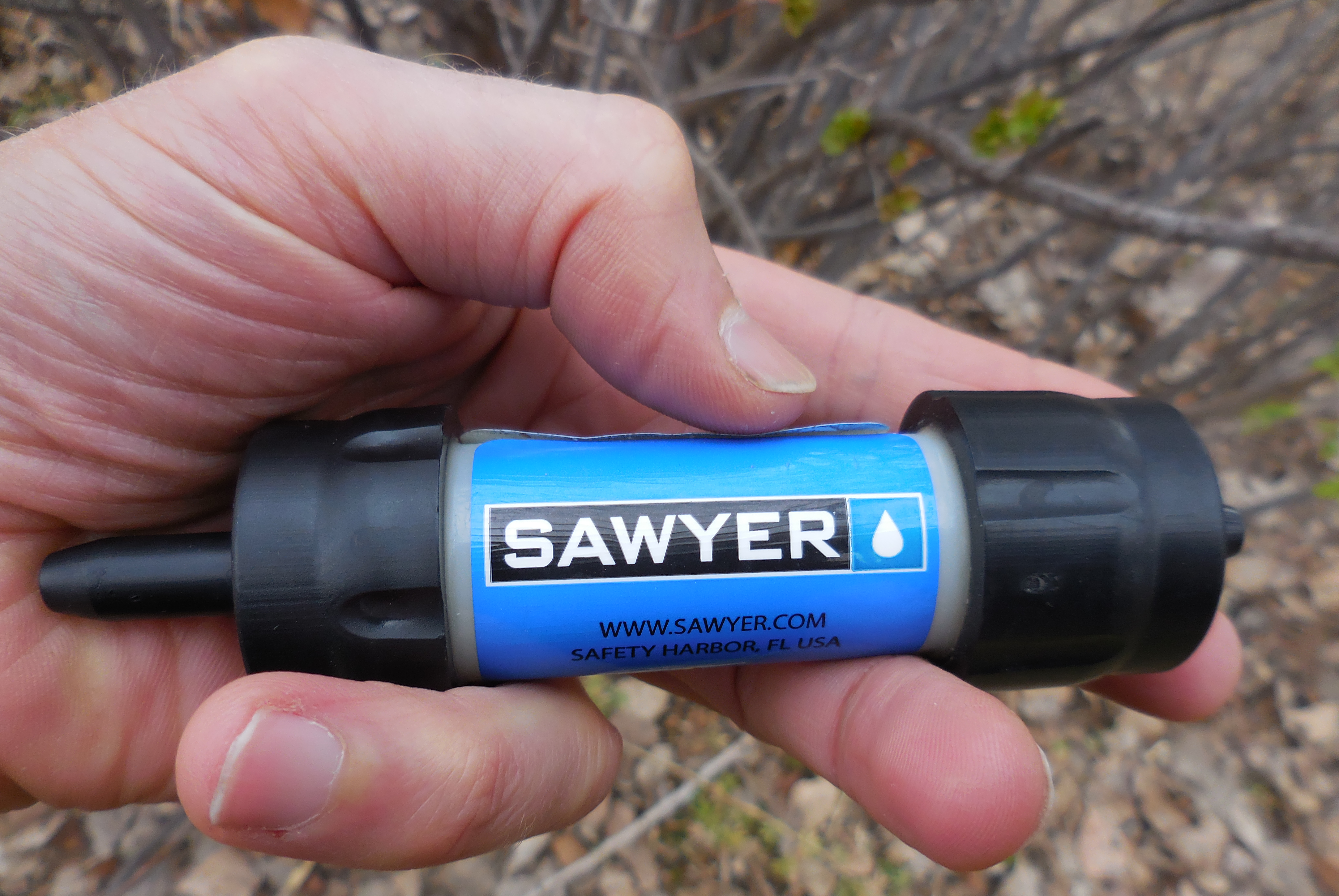
The Sawyer
Mini without the bag. $25, no BPA,
2oz, back-flushable, & a claimed 100,000
gallon lifespan.
|
|
If the Katadyn
Pocket filter did not exist, I'd give the MSR
Sweetwater filter another look. I used them for years
in both turbid and clear water conditions. They performed
decently but, like other all plastic constructed filters,
they are not overly robust. The pump shaft broke on
one of mine, and not realizing it until I had drank
1+ pints of water rife with cow waste, the cartridge
failed on another. The other filters
I have tried either cloged too quickly in turbid water
or, for my liking, had too many small parts that could
easily be lost while cleaning in the backcountry.
Now, if I
was filtering clear water only, and
the Sawyer Mini filter was
not available, I would opt for the slightly larger version:
The Sawyer Squeeze. For a pump filter, the Katadyn Hiker
is decent. It's simple and performs quite admirably.
I would not recommend the "Pro" version though.
While the quick connect fittings are nifty, the one
on the base is very prone to breaking. I have seen one
break rendering the filter next to useless. I have also
found their "removable filter protector" to
offer no advantage. Regardless, one should also keep
in mind that even the lightest pump filter is ~6 times
heavier than a Sawyer Mini.
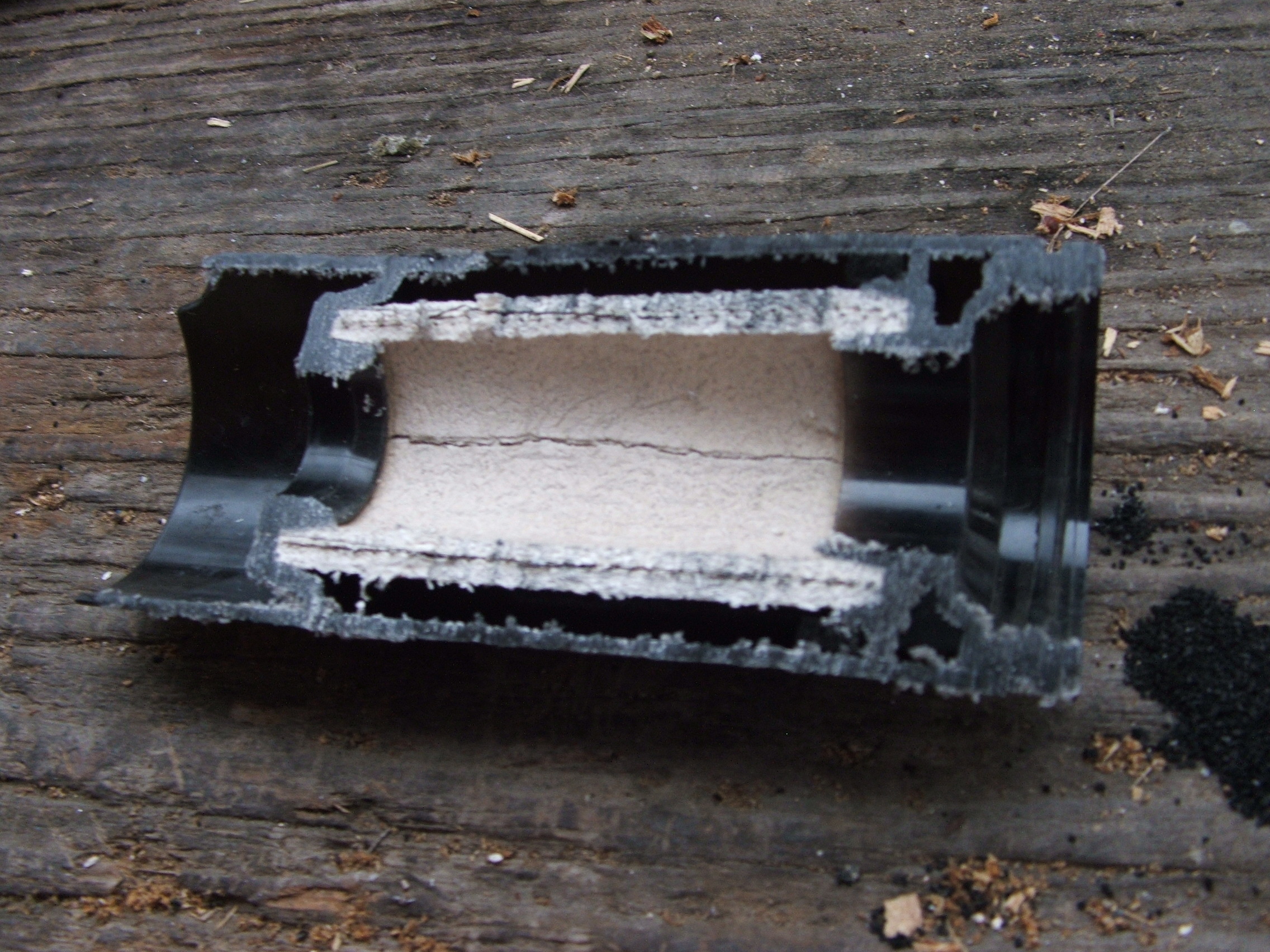 |
A
filter cartridge cut in half. Note the crack running
the length of the white part. By the time I realized
the filter was not filtering, I had already drank
20 oz of water obtained from a feces ridden cow
trail leading into a turbid creek...the only place
I could find. This was the moment of the realization
that carbon (black stuff to right) really does remove
undesirable flavors. The water tasted great! |
Boiling
While boiling is recognized as being a surefire method
of dealing with protozoa, bacteria and viruses, it has
several shortcomings. Boiling will not remove chemicals;
the water will taste flat (a pinch of
salt will help); it's time consuming; it takes
a lot of fuel; no sediments
are removed; and lastly, unless you like your water
hot, you’ll have to wait until it cools. Even
then, the water will only reach the ambient air temperature.
However, other than chemicals that
could potentially be in the water, none of these weaknesses
are a problem when cooking a meal that requires boiled
water. In these regards, boiling is actually
the preferred route as you'll get food in you mouth
quicker and be saving your filter or purifier's filter
cartridge along the way. The boiling treats
the water so no need to filter or purify. Just dip your
pan in the creek/river, boil and eat!
According to the CDC,
one should bring the water to a rolling boil for 1 minute
at altitudes under 6,500' and 3 minutes above.
Chemically treating
There are quite a few chemical treatments on the market
and they all share the same trait that makes them so
desirable to some: Lightness. When in tablet form, enough
for the typical self-support trip would weigh no more
than a stick of gum. Additionally, there’s little
cash outlay for the occasional user and there's nothing
to break. That’s where the advantages end though.
These chemicals don’t remove other chemicals or
sediments nor do they provide instantaneous treatment.
Best case scenario is about 30 minutes, and to effectively
treat some microbes in cold water, the wait can be up
to four hours!
Furthermore, though it
may surprise many, two of the most commonly known chemicals,
iodine and chlorine, have limited effectiveness (in
recommended doses) on Giardia, Cryptosporidium
and other coccidian parasites, the very contaminates
most likely to be in surface water. Iodine’s
lack of effectiveness on Protozoans is well covered
in Military
Medicine and the department of SWES
at the University of Arizona goes as far as recommending
a different form of treatment altogether. If that wasn’t
enough, chemicals impart unpleasant tastes more often
than not. Water treated with iodine makes me nauseous.
And, some of the byproducts left over from the disinfection
process are suspected to be, or are known to be, unhealthy.
Little is even known about some of these byproducts
as they have
not been adequately researched.
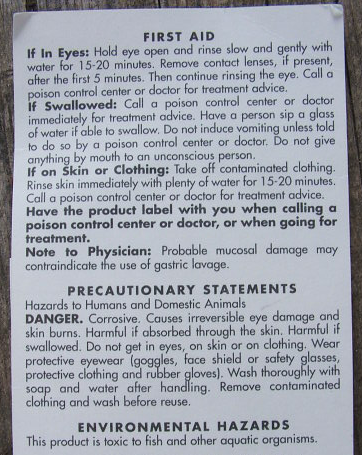
| A
tag from a packet of popular chemical water treatment
tablets. Not exactly what I'd call a turn on...(click
to enlarge) |
 |
Considering all the downsides to
treating water with chemicals, there will always be
a few who simply can not resist the obvious diminutiveness
and weight savings these treatments provide. For those,
Chlorine Dioxide might be the answer. Chlorine Dioxide
doesn't treat any faster than iodine but it does take
care of the microbes iodine doesn’t and the taste
is not as unpleasant...though I find it remindful of
some city tap water. If ones taste buds have never been
exposed to pure spring or well water, they may not notice
the difference. If one relishes the taste of unadulterated
water straight from the earth, I'd suggest another route
of treatment.
If Chlorine Dioxide is for you,
it is available in convenient tablet form from Aquamira,
Katadyn
and Potable Aqua.
One more
chemical treatment method is the MSR
MIOX Purifier Pen. It's about the size of a jumbo
cigar and works by creating brine out of untreated water
and salt, then passing a small
electrical charge through the solution creating a dose
of mixed oxidants. Basically, you add water, shake,
select the correct button, pour solution into bottle
of untreated water, check the "safety indicator
strip" and wait. Besides all the steps and the
fact it is a
battery driven electronic device,
the wait time is about the same as iodine and I have
read a number of reports saying the treated water tastes
like swimming pool water. If one was planning to treat
a lot of water over long periods, and was set on using
chemicals, the MIOX pen might be a cost effective way.
Otherwise,
it seems like an overly complicated way of achieving
the same as simply dropping a Chlorine
Dioxide tablet in the water.
Steripen ultraviolet
(UV) light purifier
The Steripen
handheld ultraviolet light purifier is an intriguing
method of water treatment. Compared to the conventional
pump purifier, the Steripen units require no setup or
cleaning and are considerably lighter and more compact.
And while not as light as chemical tablets, the Steripen
does in 90 seconds what can take chemicals up to 4 hours
to accomplish and without affecting the taste. No chemicals
needed and Steripen claims eradication of protozoa,
bacteria and viruses. Its UV light purifies by destroying
the DNA of these microbes which prevents them form reproducing.
Operation is simple. Basically, you take the lamp cover
off, turn it on, stick it in your bottle of water and
stir until the light turns off. Though this technology
is relatively new to the backcountry scene, it has been
used for years in research labs, hospitals, bottling
plants, and municipalities.
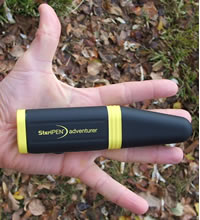 |
The 3.6
ounce Steripen Adventurer purifies 12 gallons at
90 seconds/quart on a single set of disposable batteries
or 9 gallons with rechargeables. |
Now for its pitfalls. The Steripen
is controlled by an onboard computer which means batteries
and other complexities that are more prone to failure
than simpler technologies. Though the latest iterations
are reportedly more reliable, there are still reports
of troubles in the field. Also, once its cover is off,
the lamp could be vulnerable too. While made from strong
optical grade quartz, it would be wise to not drop it.
Lastly, the Steripen doesn't remove sediment or chemicals,
and the murkier the water is, the less effective it
becomes. All that said, the Steripen may be a good choice
for vigilant people who are wanting a light, fast, compact,
and fairly convenient way of purifying relatively clear
water without the use of chemicals.
Bisphenol
A (BPA) leaching into food and beverages
Bisphenol-A (BPA) is an endocrine disrupting chemical
used in plastic products, including some kinds of water
bottles, baby bottles, and food storage and heating
containers. It is also used in the lining of metal food
cans, in certain plastics used in children’s toys,
reciepts, and other things.
Though BPA didn’t reach mainstream
media headlines to any great extent before 2008, it
was first understood to be toxic in the late 30’s.
By accident, it was discovered to leach into liquids
from polycarbonate in 1987. Then again, by accident,
it was discovered to mimic estrogen in 1993. By 1997,
BPA had been linked to multiple health issues and the
intervening years saw a development of science that
established a new paradigm for our understanding of
chemical toxicity. This has prompted a number of countries
and states to limit the use of BPA. To date, several
countries around the world have banned its use in baby
bottles along with at least 11 states in the US. And
various legislation limiting or outright banning its
use is pending in a number of other states and around
the globe. Within the manufacturing world, Nalgene,
one of the most recognized names in the outdoor industry,
voluntarily chose to phase out their production line
of polycarbonate containers containing BPA, starting
a trend among competitors who are offering BPA free
bottles. Walmart, CVS and Toys 'R Us also announced
plans to discontinue baby bottles containing BPA. Other
companies are following suit.
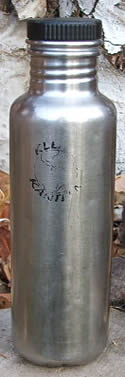 |
27 oz
food-grade stainless steel Klean
Kanteen after more than 5 yrs of near daily
use. Classy, durable, & no chance for chemical
leaching or imparted flavors with any beverage,
warm or cold. Shown here with optional staninless
steel lid. |
Despite that and scientific studies
implicating BPA in a range of human health problems
that are on the rise, as a whole, policymakers in the
US have either been slow to act or have done little
to limit its usage. This is due largely to a regulatory
process that has essentially been unchanged since 1976.
It puts the costly and time-consuming burden of proof
on the EPA rather than chemical companies and our administrators
have not provided the EPA with sufficient resources
and staffing to thoroughly address these issues. To
quote the US Government Accountability Office, “Little
is known about the risks posed by many of the chemicals
to which millions of consumers and workers are exposed.
Although the amount of exposure to a chemical can vary
greatly depending on its use, the EPA's information
on chemical use is often scarce, incomplete, or outdated”.
Minimizing exposure to
BPA. In terms of kayaking, this is easy to
do by avoiding the use of any plastic with the recycling
code #7 or the letters “PC”. Plastics
marked with the recycling code #1, 2, 4 or 5 do not
contain BPA. However, this does not
mean they will not leach other chemicals. BPA flew
under the radar for years. No one knows what may be
discoverd next which brings me to this: In the last
few years, a big marketing tool has been labeling
that boldly states "BPA Free". We do not
know if the replacements are any safer. In time, they
could prove to be just as bad or worse.
Your safest bet is to
avoid plastic altogether when it comes to beverages
and liquidity food. Although most chemicals
in the culinary field are considered "safe",
that's generally not because they've been proven safe.
They just haven't been proven to be unsafe. It
must also be remembered that hot foods and beverages
increase leaching. For this reason, I have stopped
preparing my freezedried meals in their pouches. Instead,
I pour the contents in to the pan of boiling water,
cover and let sit. Same concept and same results but
with a pan that must be washed. While not
as as convenient, convenience and health generally
do not go hand in hand.
Additionally, besides eliminating
BPA in water bottles, it would also be wise to use
metal utensils, pots (with no anti
stick coatings) and bowls made from food-grade
materials and without linings. KISS. Keep it super
simple.
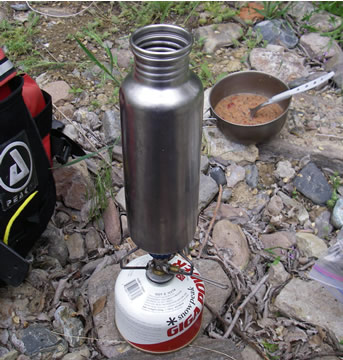 |
Making
tea in the Klean Kanteen (non-painted versions
only). Heat water on stove; drop in tea bag; drink;
refill bottle; insert in boat; paddle to next
camp. Unless you like big bangs & flying shrapnel,
do not even think about screwing the lid
to the bottle while it's on the stove! |
For further reading on BPA, visit
the EWG website and
type “BPA” into its search function. Additional
BPA info can be found on Our
Stolen Future’s website. For information on
the U.S. chemical regulatory process, visit the U.S.
GAO website and search “TSCA” (Toxic
Substance Control Act).
No
single raindrop believes it is to blame for the
flood. Some of the most toxic chemicals
known to man are carried on air masses and deposited
in places we assume to be the most pristine. Just
a few examples would be the well-documented *struggle
the Inuit peoples of the Arctic are having
with dioxins; the agricultural
chemicals and other compounds found at high elevations
in many North American national parks and
here;
and very high levels of mercury in the waters
of southern Idaho near some of the most remote
self-support runs in the Lower 48. It is unknown
how these chemicals may or may not affect the
backcountry traveler. That isn’t
the point though. The point is this:
Never assume you’re in a ecosystem unaffected
by mans actions. Also, as harsh as it is, remember
that we contribute to this issue each time we
support the PVC industry, eat non-organically
grown food, and turn the light on.
*Watch
a video trailer
of "Invisible", a documentary of Inuit
mothers whose bodies are contaminated with chemicals.
Click here
for a lengthier version.
Just
in, Feb 26, 2008: National Park Service
overview and announcement of the Western Airborne
Contaminants Assessment Project. Click
here. |
General tips
- If using anything but a bottle
filter, consider taking
the largest water bottle you can realistically take.
Otherwise, you'll have to take the time to dig your
system out of the kayak and treat water in between
camps to stay hydrated throughout the day.
- For a convenient camp measuring
cup, graduations can be applied to your bottle with
a permanent marker.
- If you are launching anywhere
below human development, whether it’s a farm,
single cabin, small village or ranch, assume the possibility
the water is contaminated with undesirables, including
chemicals. While some methods may disinfect the water
fine, your safest bet is to treat water from small
side streams/springs.
- Always
test your water filter, or purifier, for function
and/or potability before your trip. It’s not
uncommon for bacteria to cause some charcoal filter
cartridges to go foul after a certain amount of time/use
and some filters, such as the Sawyer Squeeze, may
require a pre-soaking to restore flows after lying
idle for a period of time. I have been stuck without
a functioning filter twice due to not testing prior
to the trip.
For more in depth reading on water treatment
options, check out this
excellent page on the Zen Backpacking site.
|