Considering how light shelter
can be these days, the rewards of risking a night of
rain or the constant pestering of biting bugs is little.
Plus, finding natural shelter isn’t always easy
and it shouldn't be expected of those with shelters
to pass up otherwise nice camps looking.
This is also a good time to mention
the risks involved when sleeping in caves, overhangs,
or old cabins. These places
are prime habitats for rodents which can carry Hantavirus,
a disease transmitted to humans through the inhalation
of airborne particles released after the disturbance
of dirt or dead vegetation the infected rodents have
defecated, urinated, or chewed on. Though rare,
Hantavirus is a serious respiratory disease with a sobering
mortality rate of 38 percent. And contrary to popular
belief, Hantavirus is not primarily confined to the
Four Corners area. Every western state has reported
cases and more than half of all cases have come from
outside the Four Corners region. For more information,
visit the Center
for Disease Control (CDC)
website.
Tents
A good tent will keep you comfortable in nearly any
condition. While inside, one can sit up and move around,
find reprieve from bugs and stay dry during the worst
of storms. As nice as they can be though, many do not
give tents serious consideration due to the perceived
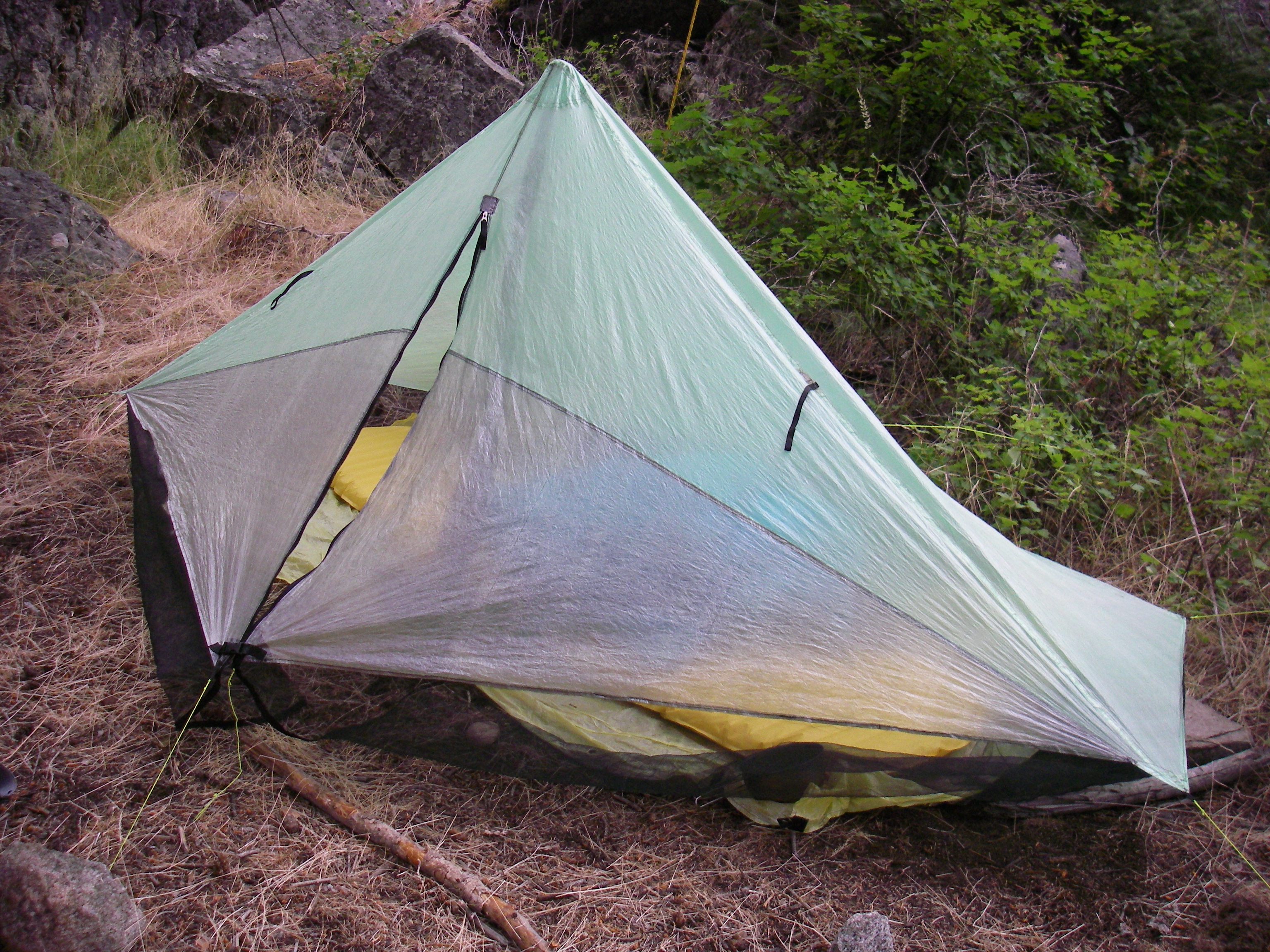
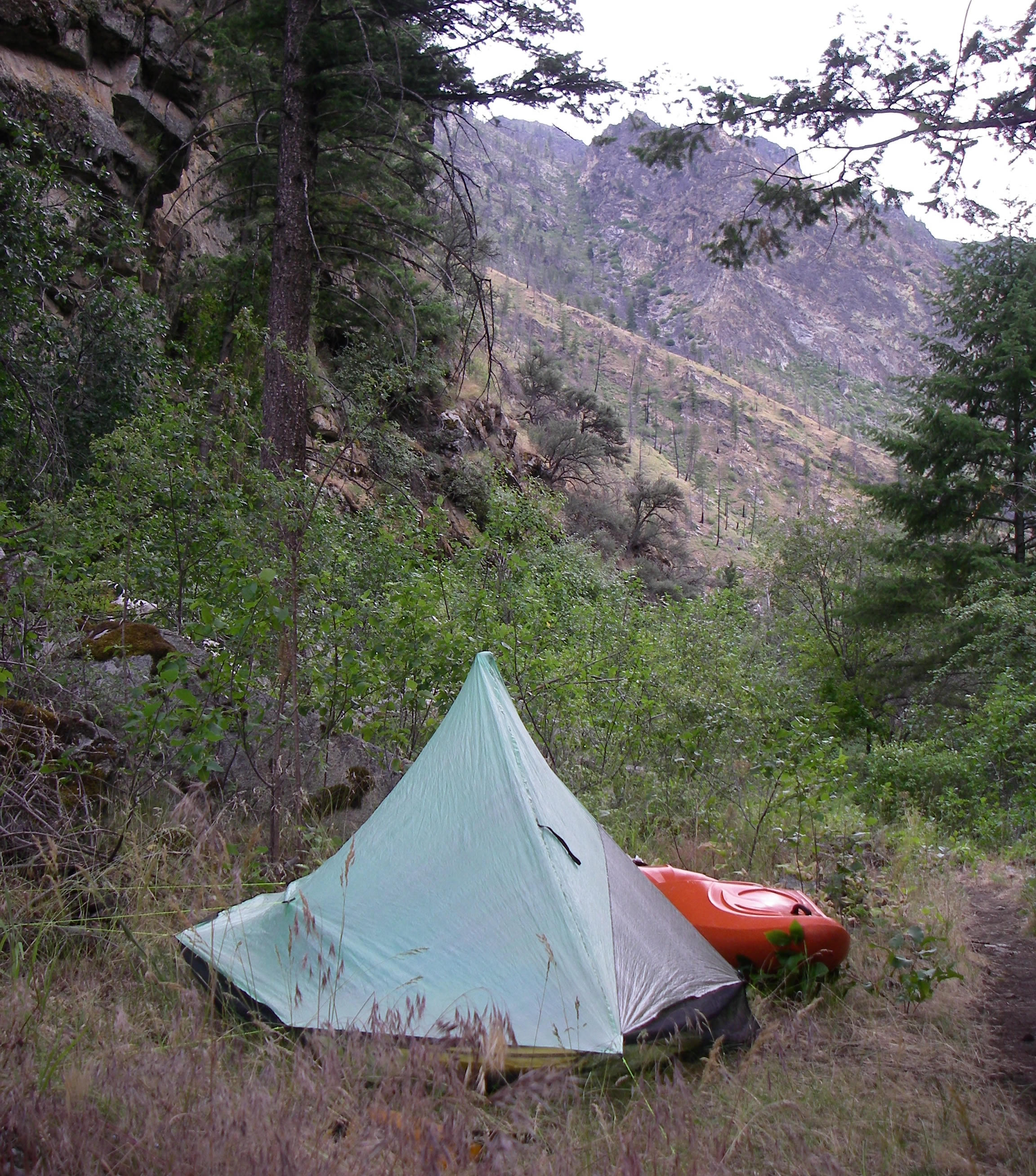
weight and bulk. However, there are large one-person
tents that weigh as little as 1 pound, and two-person
tents in the 2 to 2.25 pound range. How
can a tent be that light? It's a combination
of using a well thought out single wall design and high-tech
materials, or more specifically, sil-nylon (siliconized
nylon) and Dyneema Composite Fabric (DCF), formerly
known as Cuben Fiber.
Sil-nylon is a rip stop nylon which,
has been impregnated with silicone during the manufacturing
process. The result is a waterproof and extremely light
material that, unlike standard tent fabrics, is not
prone to delaminating over time or soaking up moisture.
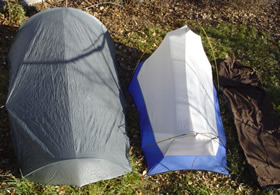 |
| Smaller
isn’t always lighter. On the left
is the older model Henry Shires Cloudburst 2 tent
at 2 lbs 3 oz. On the right is what used to a top
selling “backpacking” 2 person tent
at 3 lbs 8 oz. To further illustrate this, to the
far right in the shadows, is a bivy bag w/ no pole
or bug netting weighing in at 2 lbs. The moral:
Look beyond the corporate conglomerates for the
lightest & most innovative shelters. |
Advantageous as it is, sil-nylon
requires a little more attention than the industry standard
materials. While quite strong for its weight, it’s
not bomb-proof. It is also annoyingly slick making it
difficult to keep the sleeping bag from sliding around.
And, the silicone attracts sand like a magnet does metal.
Dyneema Composite Fabric (DCF)
is a more recent, and exotic shelter material. Most
commonly used for yacht and other sails, not only is
DCF lighter than sil-nylon, it is stronger. It also
does not have the annoying slipperyness sil-nylon has
nor does it stretch when wet, or attract sand. Not surprisingly,
it is considered the ultimate shelter fabric for ultra-lighters.
It does however come with a price...literally! DCF is
roughly three times the cost of sil-nylon.
For the masses these materials are
not. However, if one understands their limitations --and
are willing to work with sil-nylon's idiosyncrasies
(see 'dealing with sil-nylon' below)--,
a well designed tent made of sil-nylon or DCF is to
a serious lightweight traveler what a finely tuned piano
is to Mozart's ears... particularly DCF.
Well
designed and non-corporate USA made ultra-light tents
www.tarptent.com
www.sixmoondesigns.com
www.gossamergear.com
www.zpacks.com
www.mountainlaureldesigns.com
NOTE:
Many tents do not come with sealed seams. The cottage
gear makers will do this for you or, you can save your
pennies and do it yourself. Click here
to find out how.
Dealing with
ultralight sil-nylon and Cuben Fiber shelters:
If a sil-nylon or DCF
tent sounds like your thing, below are a few points
to keep in mind... and a cure to one of the quirks of
sil-nylon. With a little extra attention and some common
sense, a well cared for ultralight tent will out last
a carelessly handled tent made from traditional materials.
Caring for sil-nylon and DCF tents:
- Before setting up, clear area
of sharp objects including sticks, pine cones &
rocks. This is particularly important where your body
weight will be. Sand is good but makes for a mess
being that silicone attracts it.
- Though not necessary if following
the above advice, providing additional floor protection
isn't a bad idea for some of the lighter sil-nylons
and cuben fibers. In lieu of a separate “ground
cloth”, save weight and bulk by using something
you’re already carrying (wetsuit,
poncho, closed-cell sleeping mat) or, use what
nature has provided
(grass, moss, leaves, etc).
All this adds insulation and cushioning too. Double
duty! And don't worry about complete floor coverage.
Focus on the area most susceptible; where your body
weight will be concentrated.
- Make sure to set up the tent
far enough from branches that they can't rub against
the material during a breeze.
- When taking down, gently shake
off excess moisture then hang dry for a few minutes
on each side before packing.
To cure sil-nylons slipperiness:
- To give your sleeping bag or
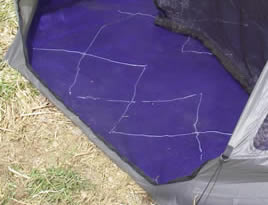 pad
something to grip to, you'll have to apply 100% silicone
to the floor when the tent is set up (silicone
is the only thing that'll adhere to sil-nylon).
This can be done by applying the silicone from a caulking
gun or squeeze tube in lines approx 6" apart
and perpendicular to the length of your sleeping bag
or in zigzags as shown in the photo to the right.
It doesn't take much so keep the beads of silicone
small and thin to save weight. I have found an area
2' x 4' per person to be sufficient. Another, and
less visible method is to mix approximatly two parts
silicone to three parts low-odor mineral spirits or
Coleman fuel and paint it on solid or in lines. pad
something to grip to, you'll have to apply 100% silicone
to the floor when the tent is set up (silicone
is the only thing that'll adhere to sil-nylon).
This can be done by applying the silicone from a caulking
gun or squeeze tube in lines approx 6" apart
and perpendicular to the length of your sleeping bag
or in zigzags as shown in the photo to the right.
It doesn't take much so keep the beads of silicone
small and thin to save weight. I have found an area
2' x 4' per person to be sufficient. Another, and
less visible method is to mix approximatly two parts
silicone to three parts low-odor mineral spirits or
Coleman fuel and paint it on solid or in lines.
Bivy bags
Though not the most enjoyable shelter to wait out a
rain storm in, bivy bags can be effective shelters that
require a fraction of space a tent takes up. This opens
up a great deal more camping spots. A bare bones version
that can keep you dry and protect you from biting bugs
can weigh as little as 10 ounces and take up no more
space than a Subway sandwich. Bivy bags can also minimize,
or even eliminate cold drafts, and add several degrees
warmth to your sleeping bag (10°
extra is often stated but that is a wild stretch in
practically every circumstance).
All this is great, unless you are
claustrophobic. Most bivies are little more than oversized
mummy sleeping bags and when battened down for a storm,
offer little wiggle or breathing room. And unless you
are a contortionist, dressing inside one is out of the
question.
 |
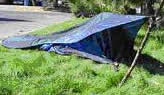 |
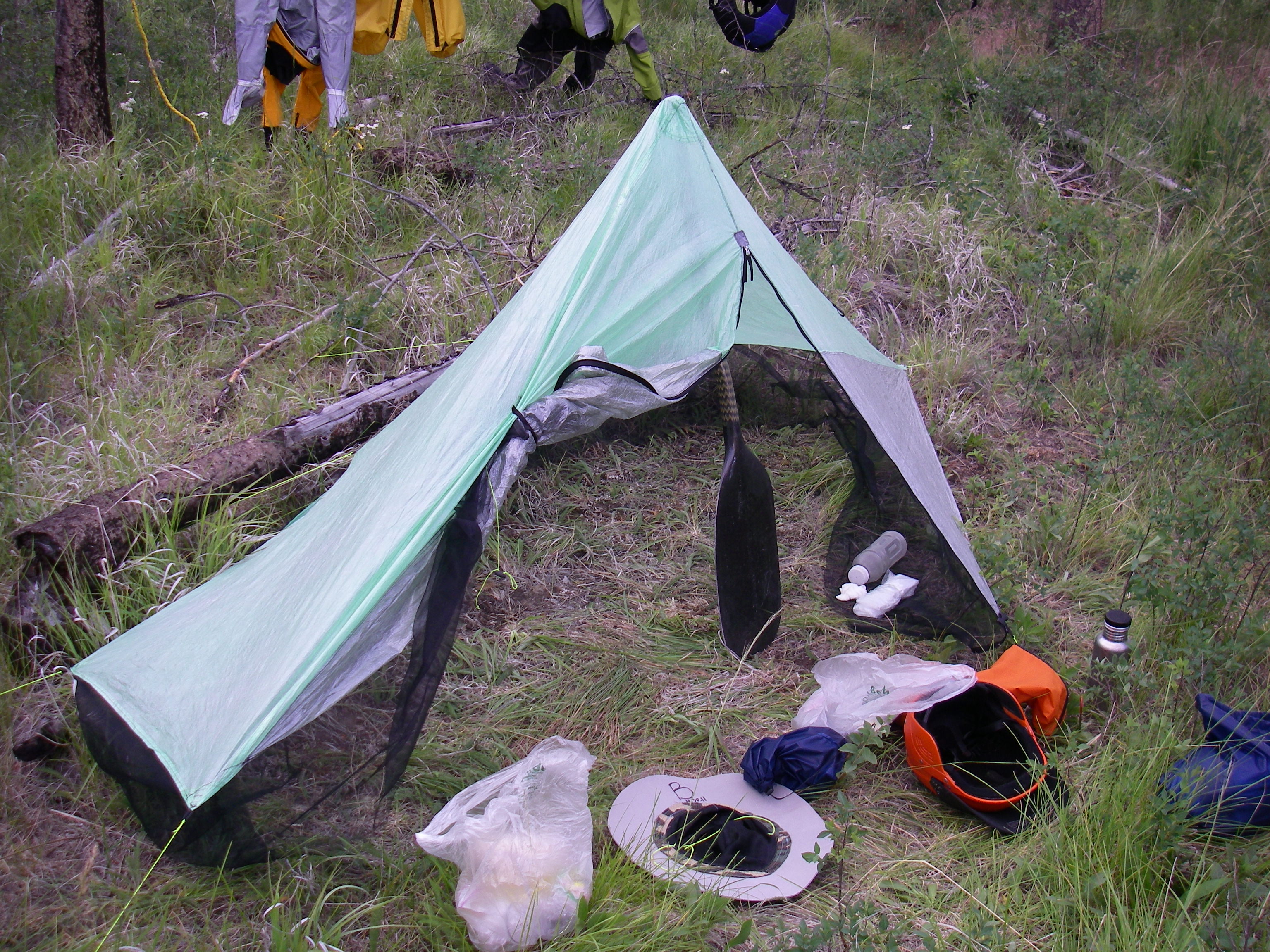
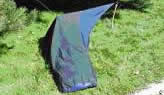
Here's
my homemade sil-nylon/Gore-Tex bivy/tent. Bug
proof; breathable; ample head room/ventilation;
adjustable for protection in any weather condition;
seam sealed; big enough vestibule to cook under
if raining; set up using trees, sticks, bushes,
breakdown paddle or packframe;
18 oz total wt; $70 in materials. With some of
the newer materials available today, the weight
of this design could easily be under 1 pound.
If patient, building something like this is not
terribly difficult. Prototype by making 3"=1'
versions from old sheets. When happy w/ the design,
draw scaled plans & build it!!
For
tips on sewing, materials, etc, click here. |
If shopping
for a bivy, be aware that not all are meant
to be used as stand-alone shelters. Many bivy users
(backpackers for instance) purchase
the type with a breathable water resistant fabric on
top and use them in conjunction with a tarp or, inside
snow caves or other shelters where only a little moisture
is likely. However, if used in the open and it rains,
a breathable "water resistant" (DWR)
fabric is not going to keep the occupant dry. To be
suitable for a stand-alone shelter, the bivy top needs
to be a breathable waterproof fabric. Water
resistant won't cut it. The head section also needs
to be designed in such a manner that it sheds water
away from that area while still being open enough for
the occupant to breath without fabric lying on their
face. As for the latter, some bivies have a loop sewn
to the outside just over the head area in which a string
can be fastened and tied to an overhead branch. This
is a lightweight and simple approach. Others have a
wire sewn in which can be bent in a multitude of angles
to suit your needs. And then there are those with overhead
poles. If you primary concern is keeping the lightest
load possible, be careful here. Many assume these
to be a good comprimise between tent and bivy. While
these type of bivies have their place in certain environments
(exposed ridges in extreme weather for
example...almost never a concern for self-support kayakers),
they often weigh as much or more than the tents mentioned
above.
Tarps
Though tarps offer no bug protection and limited refuge
from wind, they are popular with some. Finding one that’s
lightweight can take some careful shopping though. By
the time you include stakes, cord for tie downs and
a ground cloth for your sleeping bag, this setup can
easily outweigh a roomy sil-nylon or DCF tent that offers
superior protection. On the other hand, if you do your
homework, a well thought out tarp can make an inexpensive,
light and compact rain shelter. And without a doubt,
in rainy weather, a group tarp really shines as everyone
can congregate and cook in
comfort.
| In
a pinch, use 3-4 mil plastic sheeting for
a tarp. No need for grommets. Just use sheetbend
knots to tie the corners out and your throw rope
for a ridgeline. Not durable but cheap & light. |
What ever the application, with practice and some improvision
with trees and paddles, tarps can be set up in a variety
of ways to fit varying conditions...though it only takes
a slight breeze to cause an annoyingly noisy flap. That's
assuming a decent pitch. A tarp with a not-so-good pitch
is prone to being blown over and/or damaged in even
moderate winds.
WARNING:
Do not cook under a tarp unless you’re using
a small stove and the tarp is set up sufficiently
high.
Bivy / Tarp combo
With the right pieces, and good camp
selection skills, the bivy/tarp combo can be a good
set-up which offers the freedoom of cowboy camping with
rain and bug protection. Below is a stock DCF Zpacks
Hexamid tarp combined with the roomy Six Moons Design
Metero bivy. The tarp is held up with half a break-down
paddle. 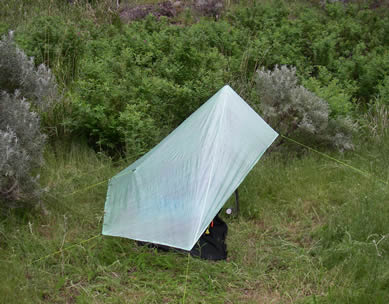
As with any tarp, the lack of wind
protection can be mitigated by placing the shelter in
an area naturally protected. Further protection in this
case is added by attaching a poncho to the underside
of the high section of the tarp and holding it to the
ground with rocks. The kayak and drybags can also be
used to block some wind. Still, these set-ups offer
limited protection in stronger wind, particularly microbursts
which can wreck havoc on the exposed tarp. Just as bad,
the flapping material can keep the entire camp awake
at night.
Not counting the break-down paddle,
the above tarp/bivy combo shelter weighs in at a respectable
12 ounces.
General
shelter tips/ideas
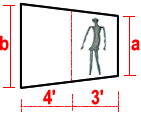 $4,
4 oz drop cloth shelter: "a"
= your height + 18". "b" = your height
+ 30". Lie on narrow "a" (3') end
& use as a groundsheet on clear nights. If it
begins to rain, just fold the "b" (4')
end over your body (leave an airspace to
breath!!). The overlap keeps rain from
pooling on the lower piece. The upper piece can
be weighted down with your paddle or rocks. The
head end can be elevated with the end of your boat
or get fancy & tie it up like a tarp by using
your throw rope and sheetbend knots in the plastic. $4,
4 oz drop cloth shelter: "a"
= your height + 18". "b" = your height
+ 30". Lie on narrow "a" (3') end
& use as a groundsheet on clear nights. If it
begins to rain, just fold the "b" (4')
end over your body (leave an airspace to
breath!!). The overlap keeps rain from
pooling on the lower piece. The upper piece can
be weighted down with your paddle or rocks. The
head end can be elevated with the end of your boat
or get fancy & tie it up like a tarp by using
your throw rope and sheetbend knots in the plastic. |
- though the fiddle factor is
high, a bit of weight can be saved by using sticks
you find at camp instead of packing stakes
- for a heinously light & ridiculously
easy to make shelter that costs less than a 6 pack,
try a 1 mil plastic drop cloth shelter (see
diagram at right). It doesn't breathe or offer
bug protection, nor is it durable. However, in a pinch,
it'll keep you dryer than having no shelter at all.
- a 3' square piece of 1 mil plastic
sheeting makes a nice groundcloth outside your shelter
door. Weighs less than 1 oz & can be used to keep
your barefeet & other misc items out of the dirt.
Your poncho can be used for the same thing if it's
not needed for something else.
|
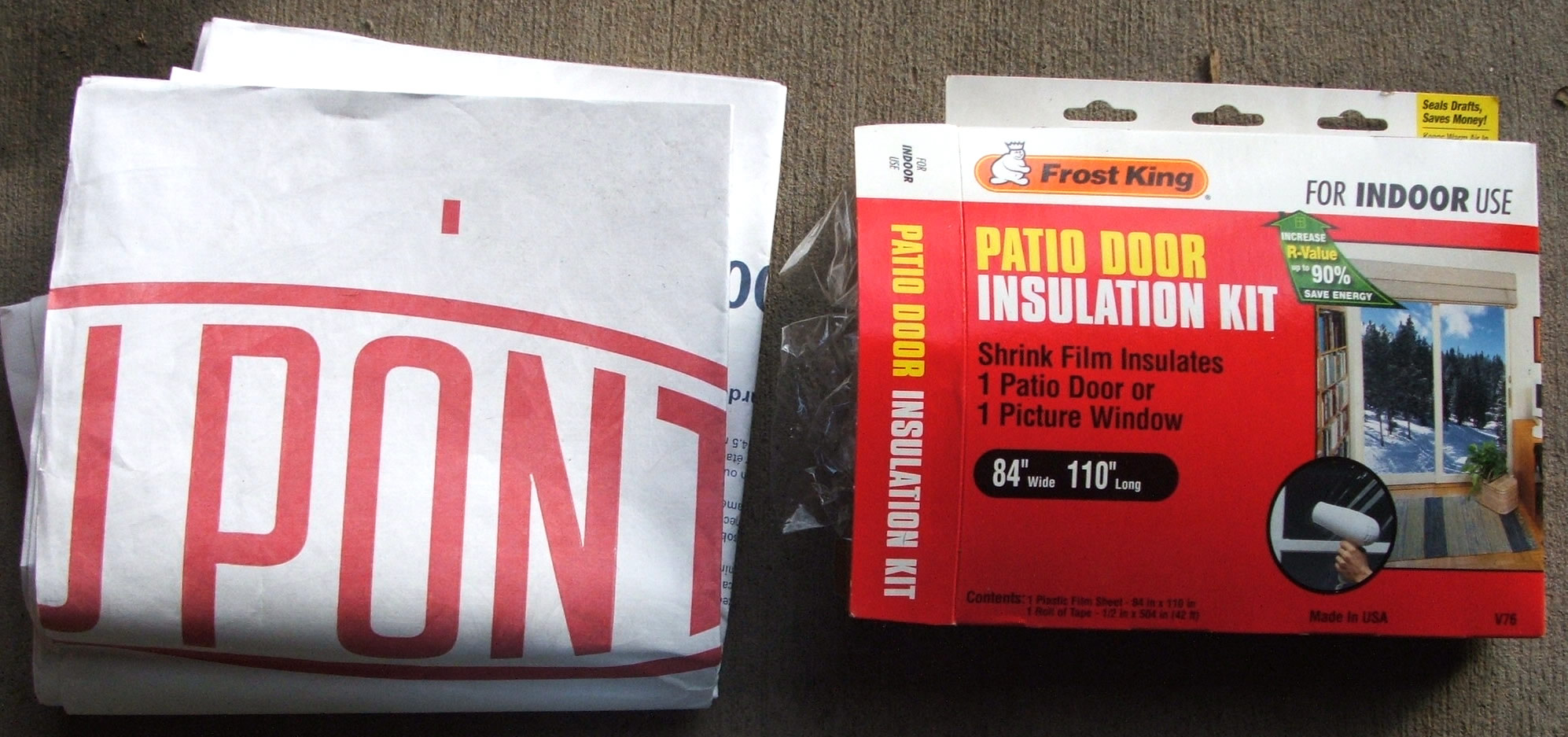
| Need a groundcloth? In the
photo above are two types: On the left is Tyvek
home wrap made by Dupont and on the right, a shrink
film window insulation kit. The Tyvek is versatile
and strong. Scraps large enough for a groundcloth
can often times be found free at construction sites
too. The window insulation kit will yield two very
large groundcloths for $8. At less than 2 oz for
a generously sized groundcloth, it is less than
half the weight of Tyvek, though not as durable.
However, this window insulation is far stronger
than it looks (resembles thick Saran wrap). It is
gold for the careful person looking to save every
last ounce! Find it at your local hardware store.
If you can't find free Tyvek scraps, it can be purchased
in small quantities at Zpacks. |
|