paddling
apparel
While wearing a drytop
and shorts with fleece might be adequate for low elevation
warm-water summer trips, this combo could prove to be
miserable or worse at other times and or locations.
Regardless of how dry your boat/skirt is, if you have
to get out of your boat to scout/portage, your lower
half will eventually get wet. Even in nice weather,
it doesn’t take much of this to get chilled. Now,
throw some cool temperatures in, a breeze, rain, or
a little Idaho summer snowstorm and the situation can
get miserable in a hurry. More critical than your immediate
comfort though is if you or one of your friends runs
into trouble. At that point, you are in an entirely
different ball game.
Erring on the safe side
is always a good habit to get into but especially
true in remote locations. Think of the worst
case scenario then plan for it. A swim is
one thing but what if you were pinned with a popped
skirt, had a boat full of cold water and had to wait
for assistance? What if you had to stand waist or
chest deep for some time holding your friend’s
head above water? Ultimately, you want to ask yourself
if your clothing is going to keep you from getting
hypothermic in long submersions. In
questionable air and water temps, there is
absolutely no question about it. The best thing to
be wearing is a one-piece drysuit.
Benefits of
a drysuit
Besides the safety factors and upped
personal comfort level, there's another benefit to wearing
a drysuit while self-supporting: You
will have dry clothes on when you get to camp. Your
paddling and camp clothes can be one and the same. Double
duty! This means less clothing you will have to carry
in your boat, which equates to saved weight and less
bulk.
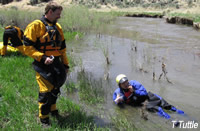 |
| Getting
warm inside that suit? No problem.
Roll, kneel or have lunch in the water. For me,
it's easier to cool off than warm up. I gladly
don my suit on everything but the hottest of summer
trips. |
Shopping for
a drysuit
Many people shy away from drysuits
because of the expense involved and the inconveniences
of urinating. However, many shops have them on their
year-end closeout sales (I have seen
them up to 40% off) and even at full retail,
there are some reasonably priced suits available now.
And every major manufacturer has offerings with relief
zippers.
- consider a
relief zipper mandatory.
Without, one tends to drink less because of the
hassle of urinating and as a result, becomes dehydrated.
Dehydration offers its own set of problems including,
but not limited to, shaky paddling performance and
chills. This counters the reason to get a suit in
the first place: Safety and comfort.
- built-in
socks aren't necessary but they are worth every
penny plus some. They keep your feet dryer and warmer;
makes the suit easier to don and doff; and don't
constrict your blood flow.
- a suit
made with breathable material will extend its range
of comfort considerably.
With a price tag ranging
from around $500 to over $1000, a drysuit with all the
above features will be your most expensive peice of
gear...but, invaluable if you are serious
about your comfort and safety. In many
cases, a drysuit can easily be the difference between
comfort and misery. In some cases, a drysuit could be
the difference between surviving or not.
Absolutely
can not afford a drysuit? Though there is nothing
that is as good as a one-piece drysuit, there are a
couple options that would beat not having one. One is
a pair of dry bibs that mate to your drytop. Like true
drysuits, bibs come in the standard nylon or breathable
materials and with or without built-in socks and relief
zippers. Sealing methods vary from neoprene body tubes
to rolling the drytops skirt tunnel to the tunnel on
the bibs.
The concept is good.
However, submersion dryness varies and as such, bibs
should not be considered as reliable as a true drysuit.
And, because of the extra material around the mid section,
bibs are not nearly as comfortable. Lastly, without
a relief zipper, urinating will be even more of a hassle
than it is with a zipperless drysuit.
Neoprene wet suits
were the standard before drysuits became available.
They will certainly help ward off hypothermia in less
severe environments and offer some impact protection
during swims. They do not offer the same level of cold
water protection or any where near the comfort of a
drysuit though. And neoprene takes so long to dry, if
you get it wet one day, you'll likely be putting it
on damp or wet the next day. Not a pleasant thought
if you wake up to snow! You'll also have to pack camp
clothes in your drybags (meaning extra
weight & bulk) as opposed to already having
them on under a drysuit. Neoprene is however, by far
the least expensive and most trouble-free option. Neoprene
can also be used in conjunction with your sleeping
pad or as a stand-alone pad if dry.
What about
dry pants? Ease of use and low prices made
pants with latex gaskets on the ankles quite popular
at one time. However, I don’t consider these “dry
pants” any kind of substitue to a drysuit nor
do I recommend them. Their ability to keep water out
in strong hydraulics and or long submersions is questionable.
And if enough water got past the waist seal and in to
the pant legs, your ability to effectively swim could
be severely comprimised. There is at least one documented
case of this contributing to a drowning.
 |
|
Getting
a lace caught on the brake pedal at a notoriously
dangerous intersection caused me to ponder the
potential ramifications of shoe laces in kayaking.
Since then, all my paddling shoes have had cord
locks to eliminate the resulting large loops.
Yes, a loop would probably come undone if caught.
When I become aware of possible issues though,
I see no reason not to take corrective measures.
Also, what would
you do if you lost a shoe during a swim, and your
boat too? To insure my shoes stay on my feet,
I run light webbing straps with side release buckles
through the small loop on the back of the shoes
and around my ankle. To minimize adding another
snag hazard, I size the strap to be as snug to
my ankle as possible without being uncomfortable.
There's little chance of a higher topped shoe
coming off but, with regular trail-running type
shoes, you can never be too sure.
|
Shoes
Shoes are one of the most often over
looked pieces of equipment in kayaking. For self-support,
a reliable pair is an absolute must, and while it may
seem like common sense, so is wearing them in the kayak.
Shoes are worthless if they’re in a boat floating
down stream without the paddler.
Constantly be asking
yourself "what if". Imagine
having to hike out. It is one thing to hike a few miles
out of an urban area creek but an entirely different
animal to hike 15, 30 or more miles out of a trailless
wilderness canyon. Unless your feet are ungodly tough
from daily barefooting, you are in dire straights without
shoes! Shoes will also allow quicker reaction times
in emergencies.
Wear the most secure,
and reliable pair of shoes that will fit in your boat...
and think twice about wearing sandals. Sandals do little
to protect your feet when walking through brush and
there has been at least one documented case of them
causing fatal foot entrapment in the river bed. They
can catch on boat outfitting too as proven by a friend
of mine during a wet exit. His sandal got caught under
the front edge of his kayak's seat breaking a bone in
his foot in the process.
Additional
tips
-
On trips that I’m wavering on the need for
a helmet liner, I’ll
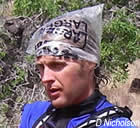 leave
it home and wear a left over food bag if need be
(bags you put bulk foods in
work well). The plastic has
little insulative power but keeps you warm by preventing
evaporative cooling...and adding a barrier between
you, the wind, and splashes. Yes, it looks goofy
but....why would you care as long as it works?
Function over fashion! Along the
same lines, these type of bags can be used on your
feet as a VBL
while sleeping (held on w/ rubberbands
at ankles) and, in emergencies, can be used
as pogies of sorts. Zip-locks or what ever, any
kind of plastic bag will work. Be resourceful,
think multi-use, and save weight without sacrificing
comfort. I have used all these methods
with excellent success. leave
it home and wear a left over food bag if need be
(bags you put bulk foods in
work well). The plastic has
little insulative power but keeps you warm by preventing
evaporative cooling...and adding a barrier between
you, the wind, and splashes. Yes, it looks goofy
but....why would you care as long as it works?
Function over fashion! Along the
same lines, these type of bags can be used on your
feet as a VBL
while sleeping (held on w/ rubberbands
at ankles) and, in emergencies, can be used
as pogies of sorts. Zip-locks or what ever, any
kind of plastic bag will work. Be resourceful,
think multi-use, and save weight without sacrificing
comfort. I have used all these methods
with excellent success.
camp
apparel
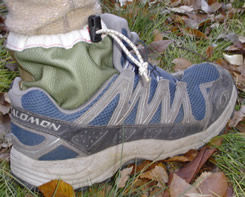 |
| At camp: wet
paddling shoes over Gore-Tex socks over dry fleece
socks. These Gore-Tex socks were tall and loose
on top so I cut them down & added a bungee cord
closure to keep debris out. |
Footwear
I used to pack neoprene socks reinforced
with Aqua Seal on the soles for warm camp wear. This
worked out pretty nice but realized a few ounces could
be saved by going another route. If I’m wearing
my drysuit, which has built-in socks, I’ll just
pack a pair of Gore-Tex socks in my drybags and call
it good. Once at camp, I'll take my drysuit off, slip
the Gore-Tex socks over the dry socks I was just wearing
inside my drysuit then put my paddling shoes back on.
With the Gore-Tex socks,
it doesn’t matter if the shoes are soaked. My
feet stay dry. This method leaves me with dry socks
to wear to bed as well. If I’m not wearing my
drysuit, I’ll just pack a pair of synthetic socks
in addition to my gore-tex socks. If it's a trip in
warmer months, I'll just go barefoot if I don't feel
like wearing my wet paddling shoes.
For sandal afficionados,
check out these easy to make 1
ounce flip-flops.
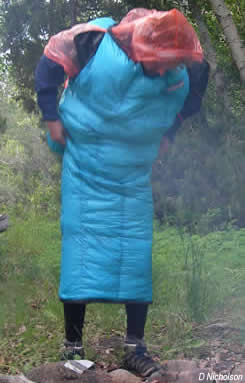 |
| "Does
this outfit make me look fat?" My
morning attire in cool subalpine: Western Mountaineering
Linelite hybrid sleeping bag over 1 oz poncho VBL
(the orange thing) over insulative layers I wore
under my drysuit. On my feet are river shoes over
Gore-Tex socks (see above photo). Minus the shoes,
this is the same get-up I slept in inside my bivy
shelter. |
Clothes
The clothes you bring for camp wear
depends on the locale, weather, time of year and whether
or not you’re wearing a drysuit and have a sleeping
bag that’s wearable.
In the hottest of trips,
I will bring nothing more than what I wear inside my
kayak. Typically though, I’ll bring a pair of
synthetic shorts that I slip on once to camp. By the
time the temps have cooled down in the evening, my wet
river clothes are usaully dry enough to don again. Or,
if I wore my drysuit, I already have dry clothes that
were worn under. If these clothes aren’t warm
enough, I just put on my hybrid Linelite sleeping bag.
Further still, I can wear my poncho under the sleeping
bag (as shown in photo on right)
or over if it's sprinkling.
It may not seem like
much but the above has served me well in a variety of
environments and temps. It's a highly versatile and
systematic approach that allows me to keep my load light
and compact.
In cooler conditions,
I'll bring a lightweight down jacket and pants. Extra
fleece works in place of down clothing but to equal
the warmth of even the lightest down garments, the fleece
will be two to three times heavier and far bulkier.
Keep an eye
on the weather forecasts prior to your trip.
The NOAA
is considered the standard for forecasting. Type
in your "location" then use their topo map
to hone in on your expected camp sites. More often than
not, I have found their forecasts to be spot on up to
four days out. Adjust your clothing accordingly. You'll
either save weight and bulk...or yourself from being
uncomfortably cold. Always pack in context.
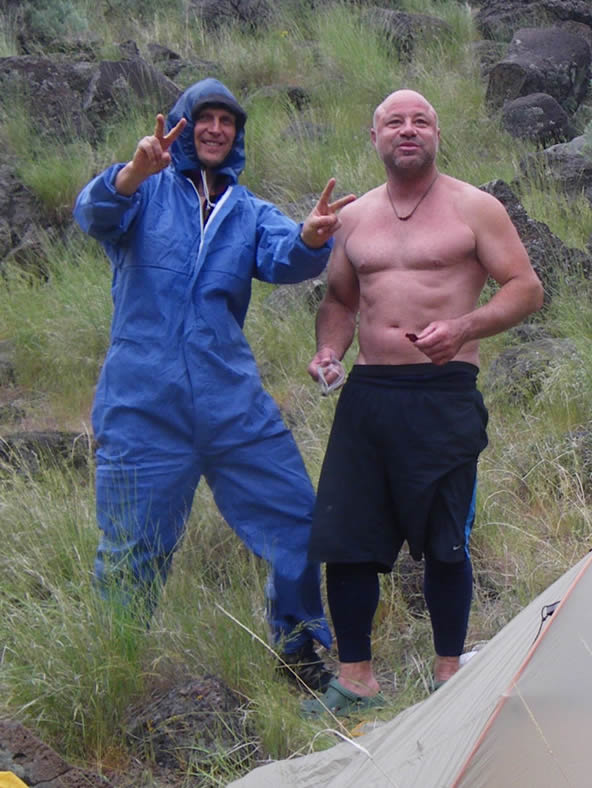 |
| YO! This is a
super cheap, super light, breathable and warm rainsuit
that'll keep you dry for about 2 hrs in a steady
medium rain...enough time for general camp chores.
It's simply a pair of polypro or Tyvek disposable
work coveralls found in the paint department of
your local hardware store. If you can't find them
with a hood, make your own from sil-nylon as I did
with this simple
hood pattern (do a Google translation). This
get up weighs 7 oz and cost around $10...and though
"disposable", will last several seasons
with a bit of care...as long or longer than the
Frogg Toggs Driducks. Guaranteed to generate camp
discussion. |
Rain
protection
Although rain suits are nice, they
are not overly versatile. Ponchos on the otherhand have
many uses. Besides being rainwear, a poncho can be used
as a ground cloth; shelter for hanging river clothes
under on a rainy night; extra shelter vestibule space;
a dry area for cooking in the rain (if
set high enough); changing pad; and if it’s
brightly colored, a signaling device (notice
how bright this red
poncho is). I take a poncho every time. Depending
on the conditions, it'll be a 3.6 oz homemade cuben
fiber job, or generic .99 cent 1 oz plastic poncho as
shown in above photo (translucent orange
under sleeping bag).
While ponchos work
great in light rain or shorter hard showers, for sustained
use in heavy rain, a rain suit may keep you dryer. The
suit is also less apt to snag on brush given the material
forms against the body as opposed to hanging off the
body like a poncho. That said, if I were going to be
hiking around in lots of rain, I'd consider a rain suit
consisting of a hooded jacket and matching pants...something
breathable yet waterproof, light and inexpensive. At
less than $20 and weighing 10 ounces, the Frogg Toggs
DriDucks fit that bill perfectly. While fragile, they
get rave reviews otherwise from many backpackers. They
reportedly hold up fine too for those willling to exercise
a little caution. Don't sit on rough rocks or bushwhack
in them. |