Paddling in the wilderness
where help could be days away should not be taken lightly.
To be as safe as possible, it takes much more attentiveness
and preparedness than paddling on a familiar roadside
run. Extra care needs to be taken not only on the water
but while scouting and hiking too. What are you going
to do with a broken leg...or a broken wrist? Even a
sprained ankle can turn in to an ordeal. You should
also pick your paddling partners with the same amount
of caution. It is best to paddle with people whom you’re
comfortable with both in and out of the water. Not only
will you be around them 24 hours a day, your life may
depend on them.
Always
be looking for trouble... not to get into it, but to
stay out of it.
General trip preparation
- Maps:
It’s
a good idea for
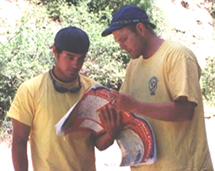 |
| Tommy &
Matt discussing emergency escape routes at the
put-in. Doing
this could mean the difference between a strenuous
all day hike & a multi-day epic. |
everyone
on the trip to familiarize themselves with the river
canyon and adjacent topography via topo maps*
and Google Earth.
Make note of all major geographical points, distances,
tributaries, trails and roads in case there’s
a problem forcing someone to hike out. You should
basically be looking for escape routes. Being familiar
with the general terrain will also make it easier
to make time/distance correlations for picking campsites,
etc.
Besides
the pre-trip study, I recommend taking a map too.
They weigh little and take up even less space.
*Delorme
and National Geographic both have good topo software.
Delorme Topo USA and Google Earth make an incredibly
useful combination.
- Gear check:
The put-in is not the place to find out your neck
gasket is ripped or water filter clogged or rancid.
Take a few extra minutes and do a thorough gear check
at home well before you depart. This may seem like
common sense but, as I have so often seen, kayakers
have a habit of ignoring this on seemingly trival
things. Trust me. Catching something at home can save
you a lot of grief later. Here are a few things to
consider:
- inspect, clean & lubricate
all gaskets and drysuit zippers
- check your drybags for holes
& make sure the closures function properly
- if you're new to self-support,
do a fit check - i.e., make sure everything fits
in your bags & into your boat
- inspect
helmet straps, buckles & liner
- check paddle for hairline cracks
& delamination
- test
water filter for function & potability (it’s
not uncommon for bacteria to cause charcoal filter
cartridges to go foul after a certain amount of
time/use)
- tighten
& inspect all kayak hardware & outfitting
- check
your shoe laces &/or straps
- make
sure your lighter works & stove lights
First
aid
An absolute minimum for any one should be a class in
basic first aid technique and CPR. A comprehensive wilderness
first aid course is highly advisable. Once you take
these courses and study a few books, you should have
a good idea what you’ll need in your first aid
kit.
Additionally:
- Whether your kit is homemade
or commercial, the contents should always be adjusted
according to trip duration, special hazards, the
particular group, location and so on.
- To save weight and space, do
not carry anything that you or your group doesn’t
know how to use.
- Have the groups most competent
paddler carry the kit and keep it easily accessible
in a separate dry container (i.e.
Nalgene bottle) or bag.
- Thinking of carrying a CPR
face shield? For quicker access (and
time is of the essence here),
carry it in your PFD pocket, not in the first aid
kit.
- Using the heimlich
to save drowning victims gets high praise from some.
I am not recommending the heimlich in lieu
of CPR for drowning...but, it may
have its place, in certain circumstances. You do
the research and make that call.
Rescue
knowledge & gear
Although it should never be expected of some one to
risk their life for you, it’s comforting to know
that your partners have rescue knowledge. They would
probably appreciate the same of you.
Take as many rescue classes as you
reasonably can and practice what you learn. Also, study
rescue videos and books*. I used the
term study because, unless you have a photographic memory,
simply looking at them once is not sufficient. After
all this, and personal experience, you'll have a good
feel for the equipment you should take. The following
is a basic overview of a starting point:
- throw bag
- three carabiners
- tow system
- knife
- whistle
- small folding saw
- rescue pfd with a built-in quick
release belt
- two pulleys - Petzl
Ultralegeres are super
light & less than $5
- two prusiks
- 1” tubular webbing anchor
sling
With a good PFD, all of this can be
carried on person, where it is easily and quickly accessed.
The throw bag and sling can be worn on your waist. See
below.
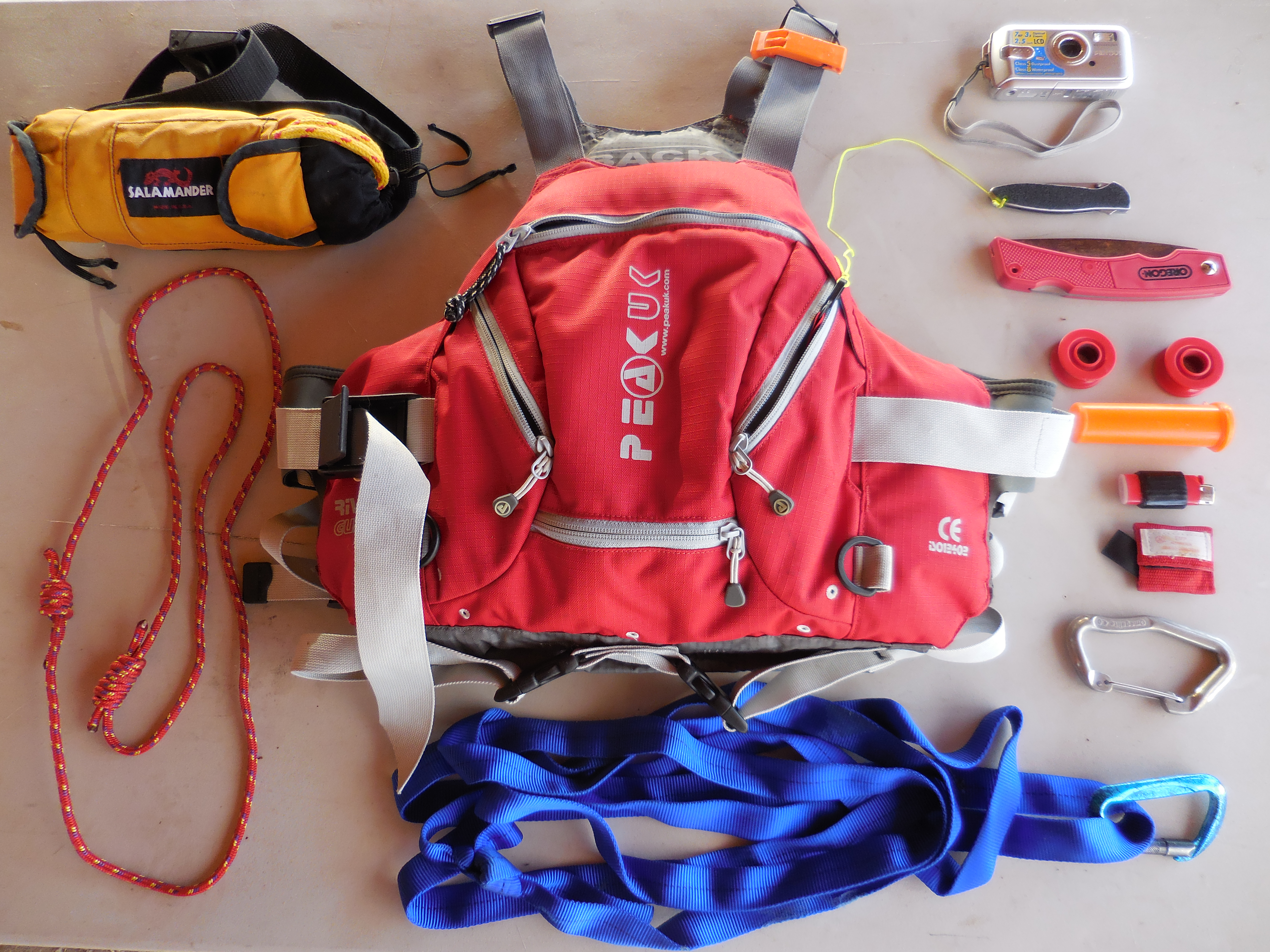 |
PeakUK
River Guide PFD with whistle tethered to shoulder
(shoulder padding removed); Pentax Optio W20 top
right; Kershaw Leek SpeedSafe knife with serrated
blade & traction tape added to handle, tethered
to PFD; Oregon folding pruning saw; two Petzl
Ultralegeres pulleys; fire starting kit in waterproof
bottle; Mini Bic with duct tape; CPR face shield;
two biners; 9' of 1" tubular webbing sling
with biner, worn around waist; Salamander Golden
Retriever worn around waist, upper left; two prussiks,
lower left. |
Additional thoughts:
- For the rope, I prefer ¼”
spectra line as it’s more compact yet has a
higher tensile strength than 3/8” polypropylene.
This higher strength makes it suitable for light mechanical
rescues. Obviously, bigger is better but......
- 50' of rope is the absolute bare
minimun on even the smallest of creeks. Longer ropes
are better. A decent way of going about it is wearing
a 50'er on your waist and hauling a regular throw
bag inside the boat of equal or greater length.
- A waist worn bag will save space
in the boat plus it’ll always be there when
you need it. From geniune experience, I have come
to put high value on having a rope on person at all
times. Beware that some waist worn bags are
prone to coming loose, potentially causing entanglement.
Check yours and your groups often....while floating,
on portages, breaks, etc.
- For quickest access, wear a sheathed
knife on your PFD. Otherwise, keep a knife inside
your PFD pocket. It will not catch on things while
inside. I prefer Kershaw Speed Safe knifes as they
are the easiest and fastest to open folding knifes
I am aware of. Some function with the same ease and
speed as a switchblade.
- Do not use a rescue PFD without
proper instruction and practice.
- Leave your neoprene socks at
home and wear real shoes
inside your boat. You are a liability to both
yourself and your buddies without proper footware.
- When worn around the waist, a
tubular webbing sling (see blue webbing in pic above)
is an extremely versatile piece of gear that's easy
and quick to don and doff. A few uses are: Anchor
point for z-drags, vector pulls, etc; dragging your
boat; pulling boat up steep/vertical pitches; lowering
boat down steep/vertical pitches; immobilizing dislocated
shoulders; sit harness; and what ever else your imagination
comes up with. Wear it like a belt with a carabiner
acting as the buckle. To minimize snagging hazards,
adjust the length so it's snug when wrapped around
twice.
You and your group must be able
to extricate yourselves from every imaginable predicament
so plan accordingly.
*Good
books are River Rescue by
Les Bechdel and Slim Ray, Whitewater Rescue
Manual by Charles Walbridge and Wayne
Sundmacher Sr, and White Water Safety and
Rescue by Franco Ferrero. For the video,
check out Whitewater Self-Defense by
Kent Ford
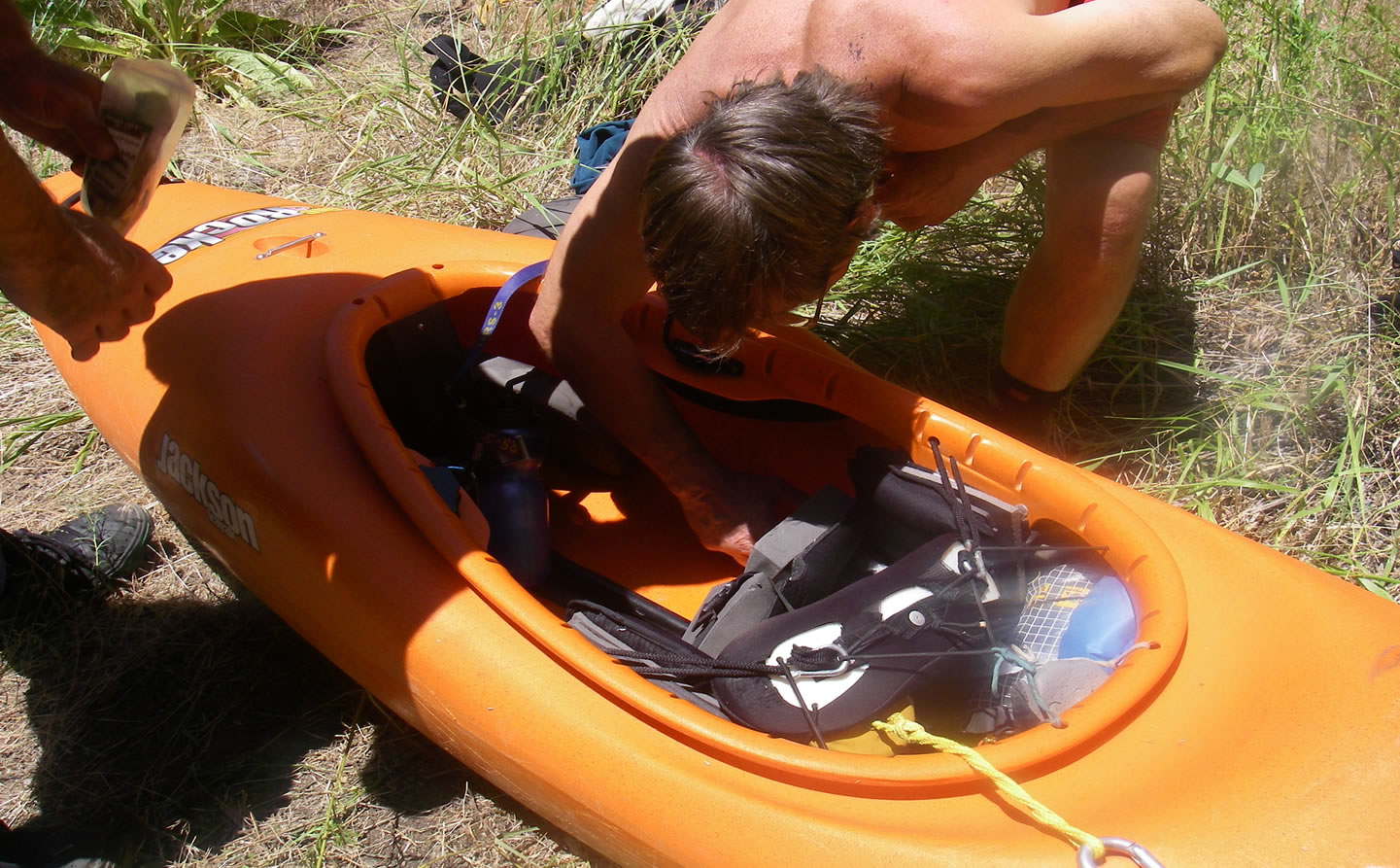 |
Boat
Repair: Always carry materials for patching
a cracked boat. My preference is
Tear-Aid (Type A) backed-up with Gorilla tape.
A friend squeezed a season of NF Payette paddling
from a cracked kayak using nothing but Tear-Aid.
In this pic, two cracks (6" & 2")
were covered with Tear-Aid on the inside then Gorilla
tape inside & out. 60 more miles of rocky paddling.
No problem! There are other methods/materials. Just
make sure your chosen is proven! Simple is good.
Regardless, it is critical to drill a small hole
at each end of the crack to arrest crack enlargement.
Tip of a small knife works. Think ~1/16" diameter.
|
Communication
One of the nice things about kayaking is that it’s
an individualist sport. However, prior to getting on
the water, it’s a good idea to work out a plan
to move more efficiently and safely down stream.
A couple things to consider:
- which signals will be used
while moving downstream and during a rescue
- who will run lead and bring
up the rear
Hiking out
No one wants to hike/climb out of a remote wilderness
canyon...especially one with no trail. But, it can happen
any where to any one. Being prepared can make your life
a whole lot easier...or even save it.
Just a few of the most common
things that might force a paddler or group to hike out:
- injury
such as a shoulder dislocation, back strain, broken
ribs/intercostal tear, broken wrist, etc
- broken
or lost boat
- river difficulties
caused from bad judgement, flows, incorrect or unknown
beta
If you are lucky, your hike may begin near the put-in
or take-out and only require minimal effort. If not
so lucky, you may have a multi-day trek to look forward
to. Depending on the conditions and or circumstances,
you may very well have to leave your boat behind and
retrieve later. At any rate, if at all possible, you'll
want to get yourself and equipment out under your or
your groups own power. Calling upon the authorities,
or other outside help where the media could get involved,
should only be done as a last resort.
Remember. This is SELF-support.
Below are a few things to consider at home in case
that dreaded day comes...all learned from misadventures
of my own, on the range and river:
- Shoes: worthy
of redundancy. Refer here.
- Orientation:
do you know where the easiest escape route is...river
right or left, how far above the canyon, etc?
Refer to "Maps."
- What to pack out and
what to leave? Assuming you have not lost
your boat, ideally, you should pack every thing out
right then. It's not often that this is a practical
option though. In these cases, take no more than what
the circumstances call for. Just stash the rest and
retrieve ASAP.
- Water: dehydration
robs energy, causes dizziness and headaches, and reduces
the ability to concentrate and think rationally...all
things you do not want at a time like this. In extreme
cases, dehydration will even lead to death.
- carry a packable reservoir,
like this,
in your PFD pocket. If you lose everything, you'll
still have a way to pack water. Even if you don't
lose your boat with your water bottle, in some
cases, you will need/want more capacity than what
your bottle has. This is particularly important
when traveling in the desert.
- If extra capacity is
needed (i.e. desert regions
w/ greater walking distances), one
can put water in a drybag/drybags and rig
a carrying system. If more than one is hiking
out, each person can take turns packing it.
I've done this. It works but the water tastes
bad and nasty stuff is almost certainly leached
into the water.
- Fire: warmth,
signaling or to keep bugs at bay.
- Always carry at least two
fire starting implements in your PFD. Lost boat,
no problem. I carry a lighter and flint.
- Fire starting material will
make your life
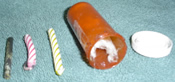 a lot easier when you are tired, hungry and cold.
I like birthday candles and cotton balls saturated
in Vaseline. Pulled apart a bit, one ball like
this will burn for nealy 5 minutes. Candles are
easy to light and burn a long time. Starting a
fire with a lit candle is often times easier than
with a lighter, and it saves fuel in your lighter.
2-3 candles, 1 flint stick (requires
practice) and a half dozen cotton balls
will fit in a standard pill vial (see
photo at right). Keep this in your PFD
pocket.
a lot easier when you are tired, hungry and cold.
I like birthday candles and cotton balls saturated
in Vaseline. Pulled apart a bit, one ball like
this will burn for nealy 5 minutes. Candles are
easy to light and burn a long time. Starting a
fire with a lit candle is often times easier than
with a lighter, and it saves fuel in your lighter.
2-3 candles, 1 flint stick (requires
practice) and a half dozen cotton balls
will fit in a standard pill vial (see
photo at right). Keep this in your PFD
pocket.
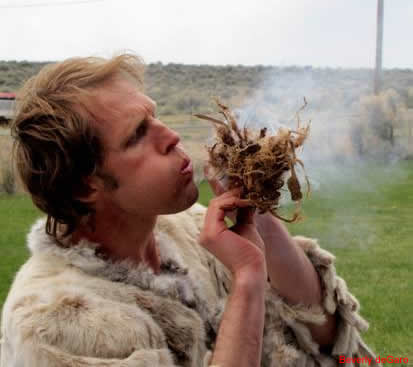
- Be able to start a fire in
any condition at any time. Practice at home if
you can't. Also, being able to start a fire with
nothing but sticks is a big plus. If nothing
else, you can wow your friends at camp while car
camping!
- Food: this isn't
an absoute nessecity but just a little can give you
a good energy and much welcomed morale boost. Food
will also help you sleep better if you get stuck out.
- If only one has to hike out
due to a lost boat, share food with that person.
Actually, always carrying a bar inside your PFD
or drysuit/drytop pocket is a good habit to get
in to.
- You will
likely be walking through, by and over various
wild edibles. Learning
to identify these food sources will make your
life a lot easier. In extreme cases, it could
even save it.
-
Signaling:
if need be, you can grab the attention of others
from miles away by simply using the sun. While a
"signal mirror" is ideal, just about any
shiny, reflective, and polished item could work:
Tin foil, inside of an energy bar wrapper, aluminum
can, polished stainless steel knife blade, etc.
Like every thing else in this section, carry the
signal device on person in a secure pocket.
|
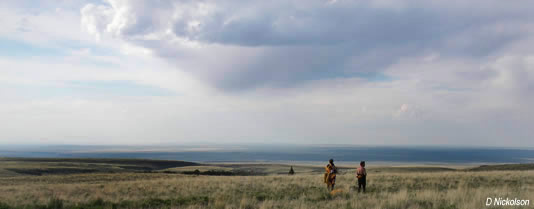
Getting
out of the canyon is only part of the challenge.
With nothing as far as the eye can see and an
injured knee, these paddlers are in for a different
kind of self-support. |
General tips
- An all too often
overlooked aspect to safety
is the colors one chooses. If you need new
gear, whether it be boat or apparel, please, do yourself
and buddies a favor and buy bright. Paddling,
pinned, swimming, scouting, etc... the gray, black
and similarly dull and dark colors so prevalent in
todays market are difficult to see and are nothing
more than camouflage in the river environment, a fact
amplified in low light canyons. Yellows and
bright oranges are the most visible (see
pic below). While better than
dark and dull colors, red, often perceived as a safety
color, is not the best choice as it has a narrow lateral
range for visual periphery. A four year study concluded
that yellow fire trucks are safer than red fire trucks
which, prompted the FAA and many community agencies
to convert rescue and fire-fighting fleets to lime-yellow.
Read more about the study of safety colors here
and here.
| No
self-respecting kayaker would be without duct-tape.
Its uses are endless from first aid to repair
& fabrication. Wrap it around several things
such as your paddle shaft, lighter, pill vial,
water bottle,
etc...or place strips inside your kayak. Several
widths come in handy too. Be seen when you most
need it & get the brightest color you can. |
- If your colors
are dull and or dark, and you do not need new gear,
tape can be used to brighten a few things. Yellow
electrical tape wrapped around a paddle shaft can
add visibility as well as grip. Just the same, a strip
or two of yellow duct tape can brighten dark helmets
and be used for a multitude of other things...if the
need arises. Double duty. Get creative!
- Any time you
get out of your boat, solidly wedge it in rocks, brush
or trees. I don't know how many times I have seen
or heard of boats sliding or getting knocked into
the water because they were carelessly placed. In
one such incident, the self-supporter whose boat slipped
in to the river broke his wrist while walking downstream
to find it. Place your paddle just as carefully...and,
out of harms way. Often times, boats tend to get stacked
above drops being scouted. No need to have your paddle
under three loaded kayaks. Stick it in the bushes
where it won't get boats piled on it or stepped on.
- Never carry non-locking
carabiners in exposed areas such as on your sprayskit,
PFD, or boat. One individual had a paddle biner clipped
to his skirt that clipped to his paddle during a hole
ride... resulting in a popped skirt, followed by swim
with paddle attached...on the NF Payette. In another
instance of weirdness, a paddler popped out of his
boat only to realize the biner he had clipped to the
deck had attached itself to his skirt grab loop. These
oddities serve as good reminders that
strange poop can and does happen...when you least
want them.
 |
Color
me bright! A good example of bright colors
that will show up in practically any environment
whether paddler is in or out of the boat, on land
or in/under the water. Orange helmet with reflective
stickers & stripes on straps, yellow drysuit
& waist worn throwbag, PFD with reflective
logos, orange boat, & yellow electrical tape
on paddle. Get bright. Be seen. Find your gear.
Be safe! |
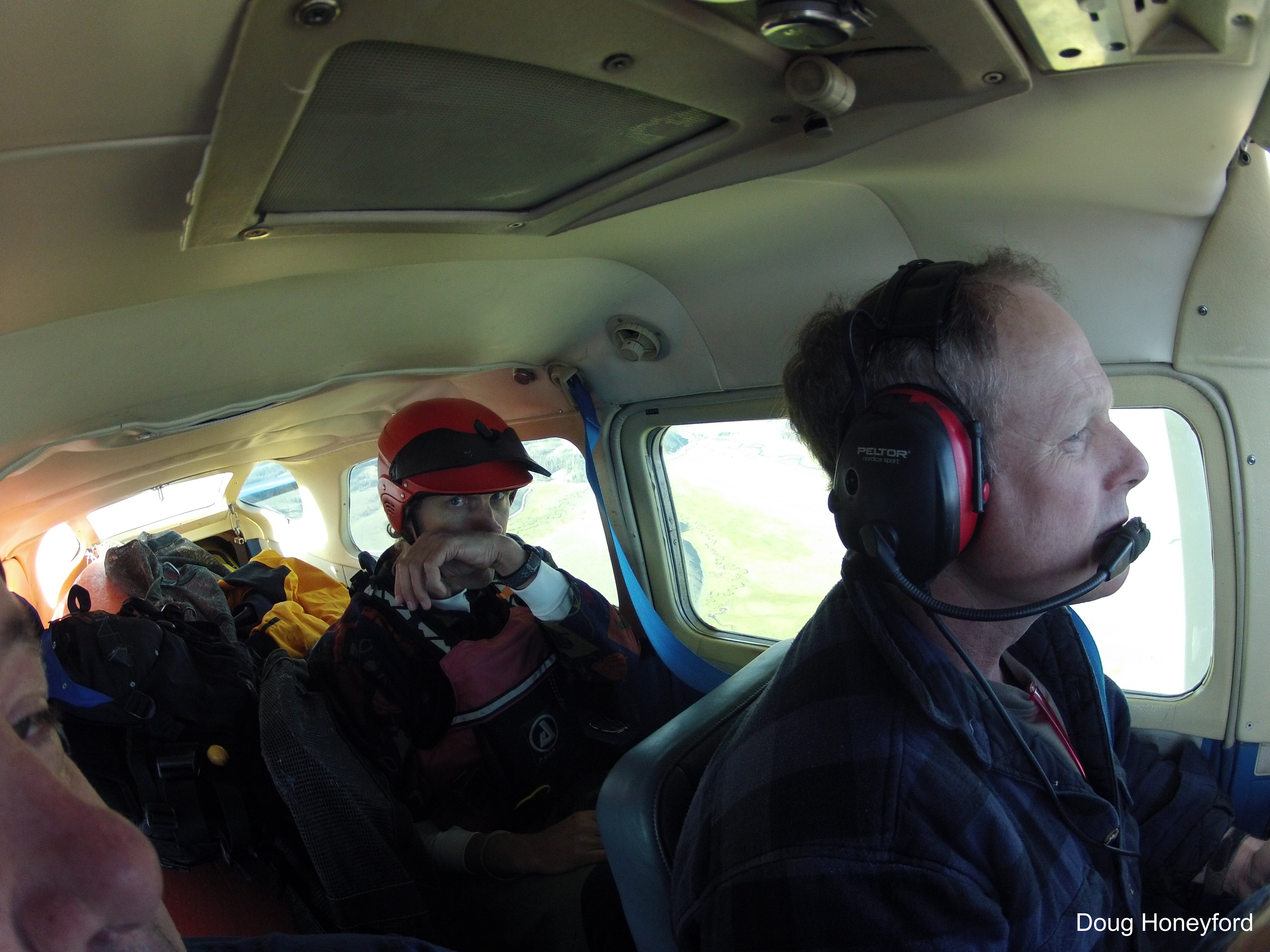
| Protect
yourself. According to a revered Alaskan
bush pilot/kayaking friend (not in pic), there have
been a number of deaths & serious injuries sustained
in backcountry plane crashes that a helmet could
have prevented. Statistically, there's an 84% higher
survivability rate when wearing a helmet. His advice
to all plane shuttling kayakers: Wear your helmet.
He dons an aviation helmet on every flight. While
at it, don your PFD for additional impact protection.
You have nothing to lose! Watch a backcountry crash
caught on tape here. |
|
 |
Lunch
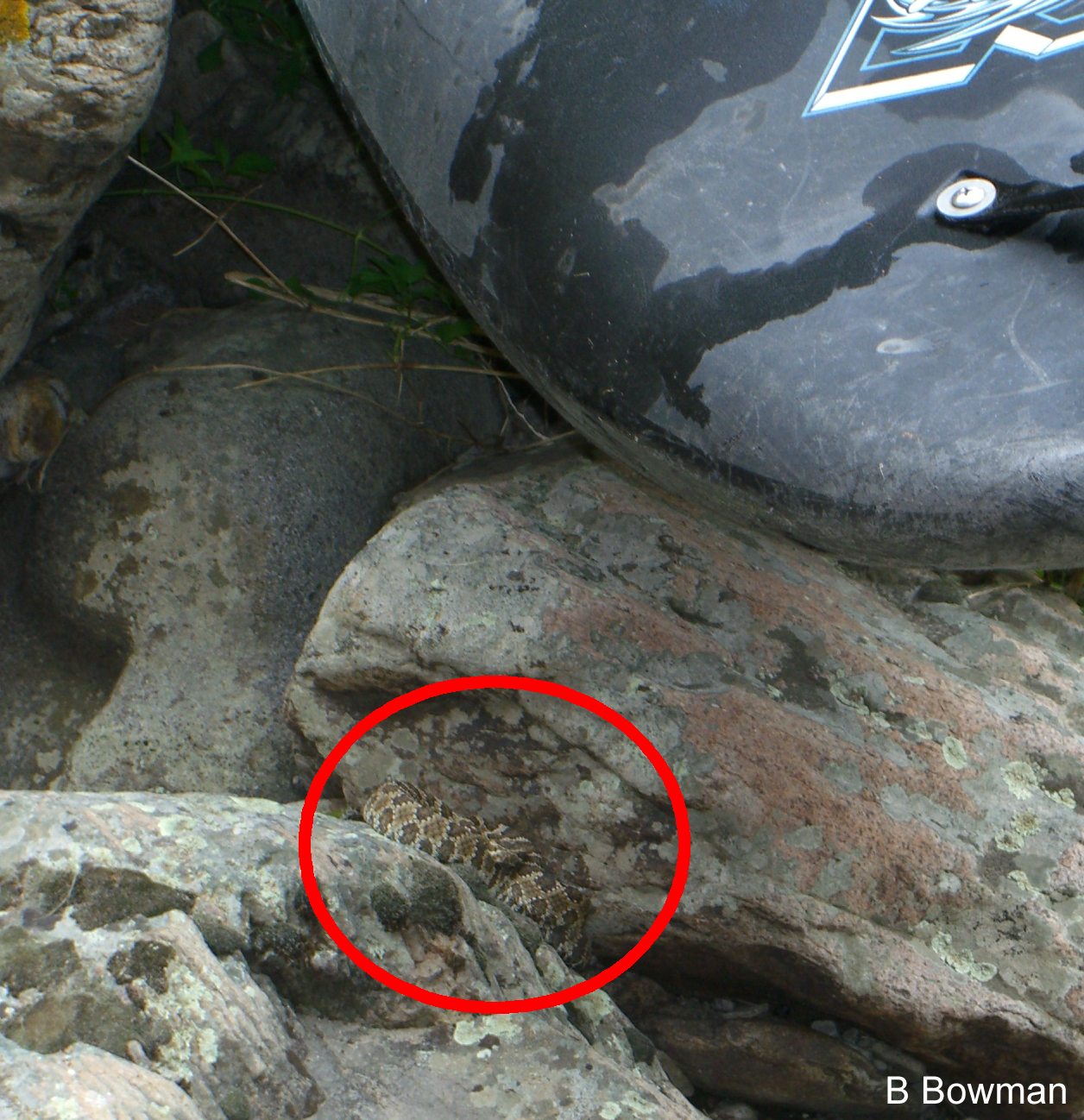
date? Unbeknowning to what he sat his boat
over, the kayaker ate half his lunch before noticing
this rattlesnake sitting near him. Rather than fleeing
like rattlesnakes prefer, this one likely felt threatened
by the boat & decided to take a stance. The
paddler didn’t hear the rattling due to the
river noise & hearing loss. This was a poignant
reminder that we need to be aware of the rattlesnakes'
existence & take necessary precautions. There’s
no need to kill them though. Forget the Hollywood
drama. Be watchful, & give them their space.
If you do that, they'll gladly give you yours. |
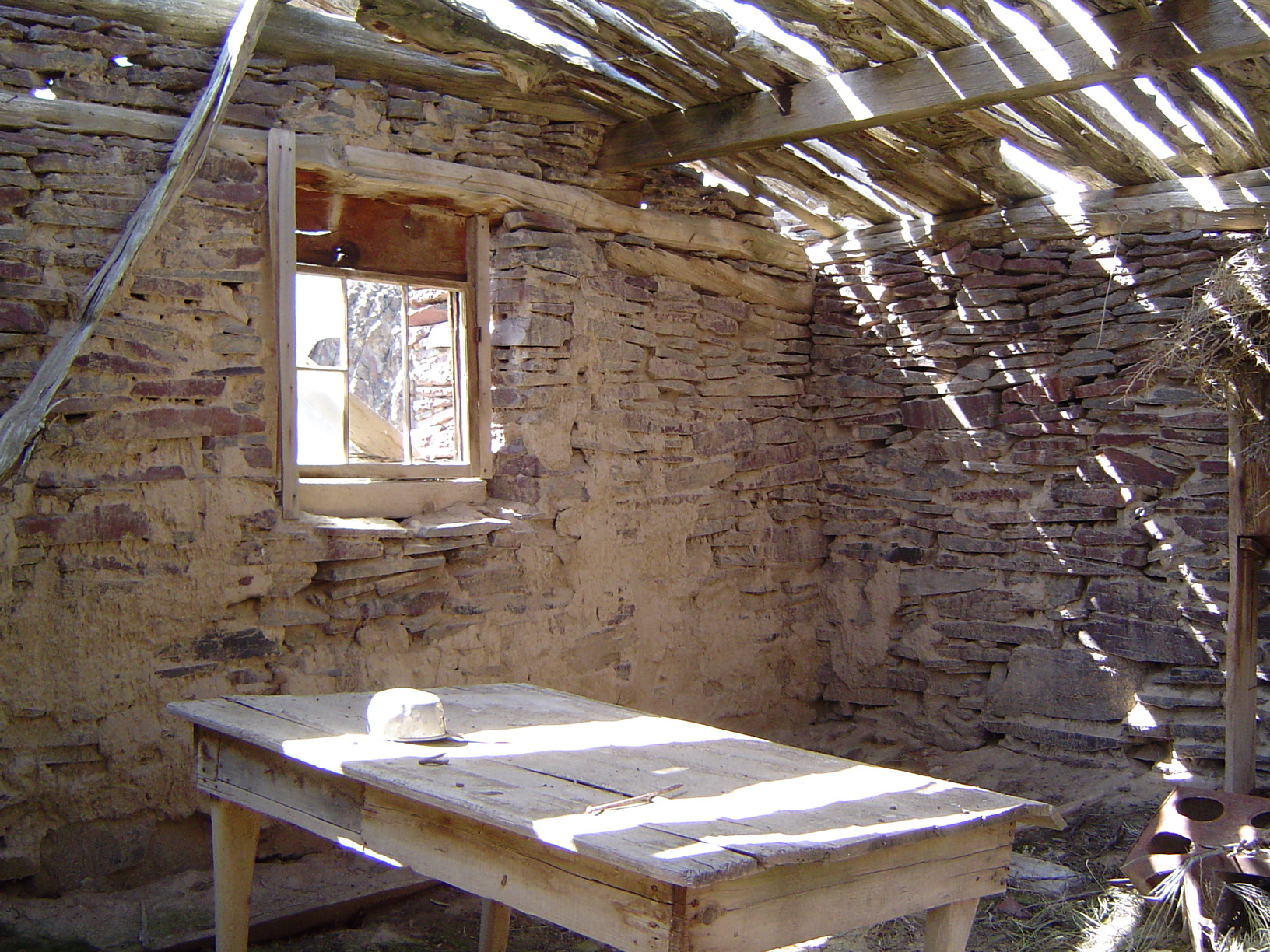
| Hantavirus
anyone? Be careful to not stir
up dust in old cabins, caves or overhangs and think
twice before sleeping in one. Though rare, Hantavirus
is a serious and infectious respiratory disease
with a U.S. mortality rate of 38 percent. And contrary
to popular belief, Hantavirus is not primarily confined
to the Four Corners area. Every western state has
reported cases and more than half of all cases have
come from outside the Four Corners region. For more
information, visit the Center
for Disease Control (CDC) website. |
|
Soloing
Whenever the
story of a solo trip into the wild goes public, particularly
one involving a mishap, it is predictable as nightfall
the soloist will be chastised. The Internet is a haven
for armchair critics looking for a story to pounce on,
giving anyone that dares to go alone a public lashing.
"Stupid" and "idiot" they proclaim.
Ironically, these same fault-finders typically have
no experience in the activity the soloist is participating
in. However, it's not uncommon for the criticisms to
come from within the very community the soloist is from.
After all, not going alone is often times one of the
first "safety" lessons we're taught. That
said, it's not always condemnation from within the circle.
There is a certain adoration that soloing garners...
particularly from the extreme sport community where
the act is sometimes glorified.
Having been
doing things by myself for as long as memory serves...a
practice born from circumstances and other factors including
the remote sheep ranching environments I was raised
in, I'm no stranger to being alone in distant areas.
Before giving it much thought, I had already done much
kayaking and backpacking  alone...something
I started at the age of 12 with my first solo overnighter.
Back then, I wasn't familiar with any labeling of the
practice. And it wasn't known to me to be a big deal
either way. It simply was what it was in a ranching
culture where being self-reliant was a way of life.
As the Internet became a fixture though, I began seeing
a wider cross section of society. I saw that going alone
was a big deal to others, whether lampooned or esteemed. alone...something
I started at the age of 12 with my first solo overnighter.
Back then, I wasn't familiar with any labeling of the
practice. And it wasn't known to me to be a big deal
either way. It simply was what it was in a ranching
culture where being self-reliant was a way of life.
As the Internet became a fixture though, I began seeing
a wider cross section of society. I saw that going alone
was a big deal to others, whether lampooned or esteemed.
Amused
yet befuddled, pondering these different views proved
to be a real eye opener for me. As my dad would delight
in hearing, it allowed me to see how incredibly privileged
I was to have been raised in that manner and in such
environments. On the other hand, placing myself in the
shoes of those with urban upbringings and more "normal"
backgrounds, I began to understand the raised brows.
From there, it got complex...considering what soloing
had become at the hands of commercialized outdoor recreation
and, more specifically, the impact Youtube, GoPros,
and social media has had on societies behavior. In short,
these technologies tend to lure people to engage in
types of behavior they wouldn't otherwise... including
soloing. The power of such enticement draws in varying
degrees of personalities, and ultimately, different
levels of competency. That said, while I don't necessarily
condone the lambasting, it is of little wonder that
some get into trouble when alone. When behavior is recognition
oriented, it becomes easy to overlook any lack of experience,
and the fact the risks are greater for some than others.
Regardless though. At the end of the day, one thing
remains the same for all: It is almost always riskier
going alone than it is with a group.
That said, spending time alone in
wild places is great for self-discovery and spiritual
development. Naturally, it also cultivates a keener
environmental and spatial awareness, independence, and
confidence. In short, solo wilderness experiences are
an opportunity for tremendous personal growth. As such,
they are increasingly being facilitated by psychotherapists,
educators, counselors, and outdoor adventure leaders
around the world. In aboriginal cultures, solo journeys
were a rite of passage. Christ, Immanuel Kant, and Confucius
also understood the value. The great American naturalists
Thoreau, Muir, and Emerson advocated it. Why then is
solo wilderness travel so often frowned upon? The answer
is complex and beyond the scope of this page. However,
I believe the gist goes something like this: Along the
way of pursuing the American dream, we gave up skills
that made us self-reliant and confident and replaced
them with considerable anxiety of being alone in the
wild. To a great extent, most modern people have figuratively
and literally become disconnected from the natural world,
seeing it instead through the narrow lens of technological
fiction. Consequently, the unknown has become a thing
of fear, and that of which was very routine a century
ago (or in my case, 40 years ago), is now considered
dangerous and foolish.
Given we are a different people
than those of the past... present day prescribers of
solo wilderness time are not typically advocating aboriginal
style journeys. And they are definitely not encouraging
people to cram themselves into tiny plastic boats and
crash through rapids in inaccessible and remote canyons.
For those with the mental and physical wherewithal though...assuming
they can break free of the ego's grasp... the values
seen in the less risky solo endeavors can be amplified
and extended to another level when self-supporting.
However, there's no mistaking that this very niche method
of travel carries considerable more risks than hiking
or backpacking alone. And the closer one gets to the
line in which their personal skill level is challenged,
the more they are risking.
I
understand the risks of soloing in remote places, and
do everything in my power to minimize them. Even with
a lifetime of experience though, to err is human, and
I accept that and the things beyond my control, for
such is life.
Level of
Risk
Based on popular opinion, it would
be easy to assume that going solo is not wise. Common
human logic supports this in the sense that there is
indeed safety in numbers. However, when the topic of
traveling solo comes up, it is often forgotten, or not
even considered, that the level of extra risk varies
from person to person. For example: Many living contemporary
lifestyles today have developed a psychological or physical
reliance on others which makes them uncomfortable being
alone in remote areas. Others tend to get into trouble
more often than their peers, where ever they may be.
Either type of person would automatically be more at
risk soloing than the self-reliant individual who grew
up in the outdoors and had a long track record of making
sound decisions. It’s no different than every
other aspect in life. Depending on one's upbringing,
background, state of presence, and natural characteristics...
some people are simply more adept at certain things
than others. What may be extremely foolish for one may
be very reasonable for another. These
points in mind, if soloing is not our cup of tea, we
should be careful not to judge those we do not know
well who do choose to go alone. They may have the independent
character to make it a choice well within reason.
Being
Honest With Yourself
If
you think you're cut out for solo self-support, you
should have already contemplated the many “what
ifs”. Hope for the best.... but methodically
and thoroughly plan for the worst.
One
must have an acute sense of awareness so as to be able
to identify trouble in order to circumvent it. When
that fails, the art is in the recovery. What is your
level of artistry?
Obviously, being pinned and unable
to free oneself is the solo paddler’s worst nightmare.
Nothing more needs to be said here. Less dire but dreaded
nonetheless, is incurring an injury to an upper extremity
and/or losing a boat. In either case, you’ll be
hoofing it...or arranging a rescue via a satellite communications
device (see photo at bottom). Another and even worse
possibility is an injury to the back or lower extremity
preventing you from walking OR paddling. Would you know
how to handle these situations? What’s your track
record on and off the river? Are you vigilant? How’s
your overall physical conditioning? What about your
sense of direction? Can you climb? Could you walk 10,
20 or more miles crosscountry, through extremely rugged
terrain with no trail? Some things to ponder. Be honest
with yourself.
Lastly, paddling in groups
tends to cause a degree of complancency in all of us.
To what ever degree it is, we should recognize it and
adjust accordingly. This awareness needs to
be acute in solo backcountry situations. If we give
our 100% to mindfullness, there will be no room for
carelessness. Below are a few pre-trip and on-the-river
reminders for solo paddling.
Pre-Trip
Considerations
Without
assistance, even the smallest mishap can lead to disaster...
and in the worst case scenario, there will be no witnesses.
 |
A PFD with
plenty of pockets is nice anywhere but of real
value for self-support & a must for soloing.
Between its four well placed pockets, this PeakUK
River Guide has room for a sizable "survival
kit" yet is still legitimately comfortable
with no large protrusions in front.
PFD kit: In
addition to what's shown here:
2 liter packable reservoir in dry enviroments;
several energy bars (inside of wrapper can serve
as signal device); mini headlamp; & cuben
fiber poncho/bag/shelter. |
- First & Foremost:
Consider your motivations for going solo. If
you could not enjoy yourself and experience personal
growth with no one knowing that your trip occured,
it is time for self-reflection. Again.
Be honest with yourself. An authentic trip will have
more meaning and be far less likely to cloud your
judgement.
- If you have considerable experience
paddling alone on day runs successfully, and solo
self-support appeals to you yet you lack the confidence,
try solo backpacking. You can then reevaluate your
desire to self-support alone. Go slow. There is no
destination to race towards.
- Paddle at least a full grade
below your skill level...particularly if you're new
to soloing. If you can paddle class 5, start out with
nothing more difficult than class 4...or better yet,
class 3-4...if you're comfortable in the other aspects
of being alone in remote and inacessable areas. However,
if your upper limits is class 3, you may want to stick
to nothing more than class 1+. Many would argue that
no one without the skills and expeience to confidently
paddle class 5 should solo. I would not argue with
that. However, it boils down to the individual. Some
crash down class 5 who'd do well to step back and
practice hard moves on class 3. Others have excellent
class 5 skills yet rarely paddle anything more difficult
than class 4. The latter is far less likely to get
into trouble and is someone who would garner more
respect and trust, on and off the water.
- Write
down a detailed plan A, B, C, etc and give it to at
least one trustworthy person that knows your abilities
in and out of the water. Do not deviate from those
plans. Also, explain your gear (what
you carry & colors) and how you would use
it (signal device, strobe light, etc)
in an emergency so others know what to look for and
expect.
- Carrying gear retrieval equipment
on person is as wise as carrying a breakdown paddle
in your boat. One solo self-supporter I know used
to carry a "pin kit" in a bag strapped
to the back of his PFD, and on at least one occasion,
used it. That works but a more streamlined method
is to use a PFD with built-in pockets (less
of a snagging hazard) containing enough volume
to accommodate this gear as well as the other things
you might want for a long hike out if that's what
you have to do. Space can be saved by wearing a waist
worn throw bag with spectra rope, using Petzl
Ultralegere pulleys, etc, etc.
- Read the above section "Hiking
out" (paying close attention to "shoes")
and have plenty of secure pockets to carry necessities
in. Remember though. The most important necessity
is carried within your cranium.
|
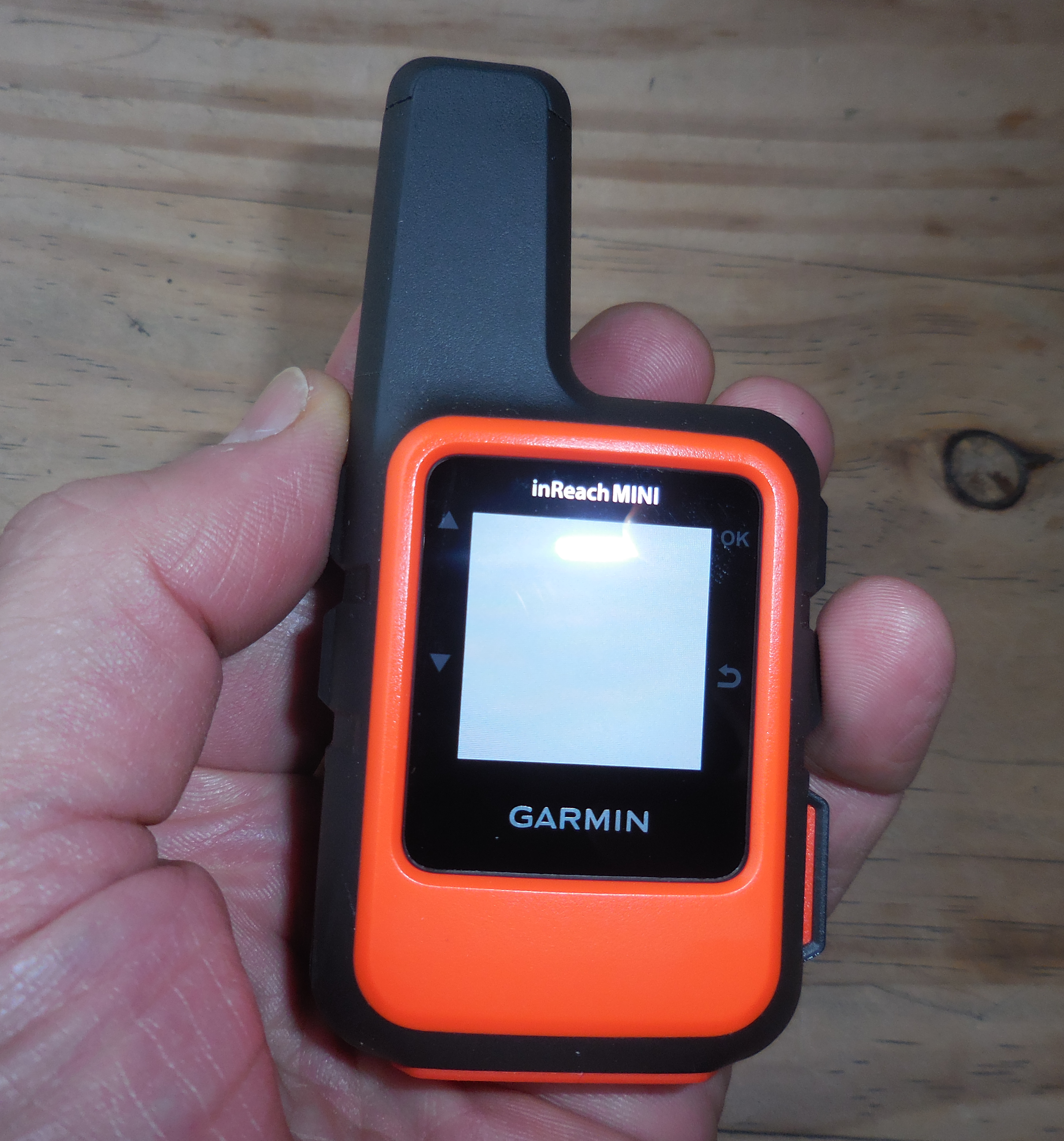 Technology
has created a cultural mindset that believes its
advances will fix every woe...an idea so entrenched
in our minds that we fail to see this very thought
process creates the trouble we seek to solve.
Rather than making corrections through lifestyle
changes, we look towards technology. With it,
we fix one problem while unwittingly creating
two new issues. Through a mix of arrogance and
ignorance, we often outsmart ourselves in a cycle
of irony. Technology
has created a cultural mindset that believes its
advances will fix every woe...an idea so entrenched
in our minds that we fail to see this very thought
process creates the trouble we seek to solve.
Rather than making corrections through lifestyle
changes, we look towards technology. With it,
we fix one problem while unwittingly creating
two new issues. Through a mix of arrogance and
ignorance, we often outsmart ourselves in a cycle
of irony.
That said, though
these devices are often times used and abused
in the same manner, I'd be amiss if I didn't mention
this piece of technology. Carried on person,
in a tiny dry-bag, a two-way satellite communication
device, like this Garmin inReach Mini, will not
only allow one to send an SOS in a life or death
situation, one can coordinate their own rescue
in less dire situations. They can be a real life
saver, figuratively and literally. Be
aware though. As soon as you let the
idea enter your mind that you can use such tech
if you get in trouble, you will be far more likely
to be less diligent in your planning, and less
attentive while out there. DO NOT rely on an InReach,
Spot, cell phone, etc to compensate for lack of
experience, planning, or judgement. Use this tech
as a very last resort, when you can not, under
any circumstance, deal with it yourself. Planning,
perseverance, and will first.
|
On The River
Considerations
(can also
be applied to group self-support)
Rid
youself of any notion that a mistake is an option. At
the same time,understand that accidents can and do happen.
Prepare yourself by running though your head every conceivable
scenario.
- Be cognizant of boat placement
(see "general tips" below). Also, if you
decide to stop for a hike, consider clipping your
kayak to a tree in case a microburst comes through.
Rare, yes, but I have seen a boat 50 yards from the
water's edge get blown into the river. Consider also
a bear looking for food knocking your boat into the
river or ripping through your drybags. Tie your boat
off like those of the old west tied their horses....and
hang your drybags, if in bear country. There's
no such thing as overkill when soloing.
- Exit your boat carefully
in the easiest place to get out you can find. In one
careless moment at a less than ideal eddy, I some
how managed to get my leg twisted and foot hung-up
in my boat that, without help, would have resulted
in a twisted ankle, swim, lost boat, or all of the
above.
- Most kayaking injuries occur
out of the water. Place each step with awareness and
forethought. Notice the sounds made by your footsteps.
This is a very meditative way of moving and can be
applied to everyday life, conditioning one to become
more aware of their surroundings.
- Unless you can see a clear route
to another escape eddy, NEVER place yourself in an
eddy you can not exit your boat from.
- Slowly and methodically work
your way downstream, running only that of which you
can see a clear route through. Scout more than you
think you need to. There is no shame in this or portaging
drops you wouldn't think twice about paddling with
a group on a roadside run.
The
choice to solo is yours and yours alone. I am not recommending
or suggesting solo travel of any kind to anyone.
The risks may involve
serious injury or death. The decision to accept that
is entirely your own. This page, and the section on
"soloing" in particular, is to serve for entertainment
and discussional purposes only. I shall have no liability
or responsibility to any person with respect to personal
harm, death, or property damage caused indirectly or
directly by any material found on this page or any other
pages in earthenexposure.com.
If you do choose to
solo, remember this: You have a moral responsibility
not only to your friends and family, but to the community,
paddling and otherwise. Those who choose not to solo
also have a responsibility. The death or injury of a
soloist inevitably paves the way to the breeding grounds
of speculation, and without a great deal of care, only
brings further misunderstanding and harm. Either way,
tread wisely.
|
|