A good sleeping pad is imperative
for a good night’s rest. Besides the obvious cushioning,
a sleeping pad insulates you from conductive heat loss
due to your body weight smashing the sleeping bags insulation.
That said, in the spirit of keeping
the lightest boat possible while maintaining a degree
of comfort, the sleeping pad has been the most challenging
piece of self-support gear for me. Having tried various
pads as well as making my own, there seemed to be no
such beast that was both light and comfortable yet compact,
convenient and warm... at least in the truest sense
of these terms. The less persnickety individuals in
the lightweight world have found a degree of content
with a simple closed cell foam or self-inflating pad,
or, a combination of those. For me, the latter was the
best comprimise...until, like a gift from the self-support
heavens, the NeoAir air mattress appeared on the scene.
More on this later under "air mattresses".
Below are the available "backpacking
light" options beginning with the earliest of the
modern sleeping pads. Remember though. While
there are some general rules when it comes to a pads
potential warmth, overall comfort is quite subjective.
What may be comfortable for one may be uncomfortable
to another.
Closed cell foam
These pads are just that: closed
cell foam. They contain no coverings or any other bells
and whistles. They are the lightest, most trouble free,
and at around $30 or less, the least expensive. They
are on the bulky side though and without modifications,
can take up a lot of room in your boat. The lightest
of these foams don't have the best of memory retention
either. In other words, over time, the pad won't fully
rebound and you may notice a small loss of cushion and
warmth.
For most people, pads with ridges
or an egg crate like pattern offer the most comfort.
Cascade
Designs Z-Lite as well as the Gossamer
Gear NightLight fall in to this catagory. Of these,
the NightLight has the best ratio between comfort, weight,
price and size.
Self-inflating
These pads consist of open cell foam
encased in coated nylon. Once you open the valve, they
self-inflate. If you desire more firmness, you blow
in more air. Not only are these pads adjustable, they
are more compact and comfortable than closed cell. They
are, however, more than twice the price of closed cell
foam pads and are heavier and require more attention.
If tossed around willy-nilly like a closed cell foam
pad, it might spring a leak leaving you with little
cushion or insulation. A patch kit is advisable.
The most recognizable name in the
self-inflating market is the Therm-a-Rest by Cascade
Designs.
Pad combos
Prior to the NeoAir, the best compromise
I had come up with for myself had been a 3/8" thick
x 60” long closed cell foam pad over a 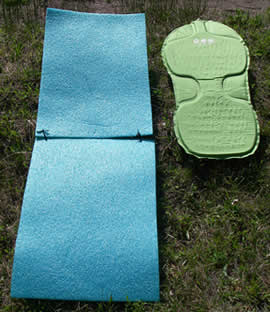 short
torso length self-inflater. The short self-inflating
pad provides cushion and insulation where it is needed
most and the closed cell pad adds to that while sufficiently
comforting the less vulnerable lower body. When cut
in half (see "closed cell foam
sleeping pad modifications" below), the
bulk of the closed cell foam pad becomes manageable
and the little self-inflater takes up no more space
than a Nalgene bottle. short
torso length self-inflater. The short self-inflating
pad provides cushion and insulation where it is needed
most and the closed cell pad adds to that while sufficiently
comforting the less vulnerable lower body. When cut
in half (see "closed cell foam
sleeping pad modifications" below), the
bulk of the closed cell foam pad becomes manageable
and the little self-inflater takes up no more space
than a Nalgene bottle.
Additionally, if the torso pad springs
a leak, the closed cell pad will still provide some
cushion and insulation. Perhaps best of all is the fact
that not only does this system offer more cushion than
the popular ¾ length Therm-a-Rest self-inflating
pad, it is longer which means more over all comfort
and it can be just as light. Combined
(see photo above), my
old Pacific Outdoor Equipment Über Lite and Coleman
Rest Easy Pad (cut to 20"x60")
tiped the scales at 16oz.
Despite not being as simple or compact
as the popular 3/4 self-inflator, I find this combo
to be superior in every other way. Together, these pads
are comparable in cost too...if not slightly less.
A few torso sized pads are the
5.6oz Klymit Inertia
X Lite, the 6oz Cascade
Designs Therm-a-Rest NeoAir Small UberLite, and
their 8oz NeoAir Small XLite.
Complementary closed cell foam pads:
- Gossamer
Gear Thinlight. Available
in 1/8", 1/4" and 3/8" thicknesses
- Coleman
Rest Easy Pad. 3/8" thickness; readily available;
$10; light; optimum cushion and insulation short lived
(best performance drops off after
first dozen or so uses)
Air mattresses
Due to thier comfort and oft time
low cost, it is often thought that air mattresses are
the ticket for a good nights rest. However, standard
air mats are convective making them suitable only for
hot nights. Yes, air insulates, but only when
comprised of many small pockets. This is why
"insulation" is installed between the studs
in a building; to replace a single large air space with
many small air pockets. Another trait of air matts that
some find issue with is the unstable feeling many have.
There are insulated air mattresses
that are both warm and very comfortable but, at twice
the weight or more compared to the popular self-inflators,
they aren't exactly what one might consider light or
compact. There is however the Therm-a-Rest
NeoAir that has a good combination of all of the
above. Its insulation comes from two sources: a series
of internal chambers Therm-a-Rest is calling the "Triangular
Core Matrix"; and a reflective thermal barrier.
Combined, these two features provide an R value of 3.2
compared to an R 2.2 for Therm-a-Rests most popular
self-inflater, the Prolite. This is enough insulation
for many to be comfortable down to the low to mid thirties...
providing the remainder of their sleep system is good.
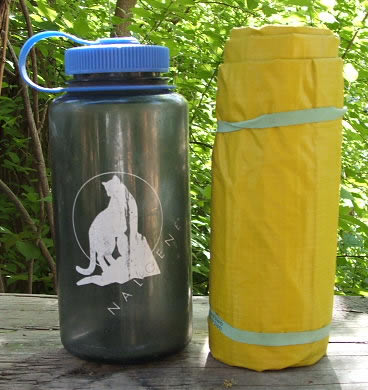 |
| The original
20"x72" NeoAir next to a standard 32 oz
Nalgene bottle set a new standard in lightweight
comfort! |
The real beauty of the NeoAir Xlite
is its comfort to weight ratio. At 2.5" thick,
it offers considerably more cushion than Therm-a-Rests
benchmark 1" thick self-inflating Prolite. Considering
that and the fact the 72" long NeoAir weighs only
1 ounce more than the 47" long Prolite, the NeoAir
Xlite has an unmatched comfort to weight ratio. For
those in warmer locales without the need for as much
insulation, there's the new 72" NeoAir Uberlite
at only 8.8oz, and an R value of 2.
As good as it sounds and is, the
NeoAir is not without downsides. The first and most
foreboding is its price. The "regular" which,
is 20" wide by 72" long, costs a whopping
$170! The second issue probably isn't a big problem
as it is easy and fast to repair but, if you're not
careful and puncture it, you'll have zero padding and
almost as little insulation left. It is made from ultra-light
weight materials and as such, is some what vulnerable.
With care, it has proven to be reasonably durable though,
and Therm-a-Rest, known for their excellent customer
service, does offer a "limited lifetime warranty".
Lastly, there is more than a monetary price to pay for
this much cushion. It is difficult for many to stay
on any of the standard 20" wide pads. When a part
of the body comes off one that is 2.5" high, it's
more noticable than it is on a pad 1" tall. This
drop off can be disrupting. This height can also cut
in to the already small foot box area of many bivy bags....though
by now, most bivy makers are aware of this.
Another company to look at is Klymit.
Offering what may be the lightest pads available, this
relative newcomer also makes some of the most unusual
looking. Rather than being solid, they have cutouts
which, in theory, allow the sleeping bags loft to fall
within and insulate. Otherwise, the insulation gets
smashed under your body's weight. Though the reviews
seem mixed, if your goal is the lightest and most compact,
they need to be considered.
General tips
- If your closed cell pad won’t
fit in the main drybags, place it anywhere in the
boat. Doesn’t matter if it gets wet. They dry
quick. And if yours doesn't dry fully, just place
it under the shelter so your sleeping bag doesn’t
get damp. It'll also double as protection for your
shelter floor. To make one of these pads fit in your
boat better, see Closed
cell foam sleeping pad modifications
below.
- Use nature
for extra insulation and cushion by placing moss,
leaves, grass, tules or rushs' under the shelter.
Tules, the material of choice for many prehistoric
people, offer the most cushion and insulation but
are not often seen in the whitewater environment.
Scouring and horsetail rush works
well too and is more common than tule. Use what ever
is available though. Just remember that the dryer
it is, the warmer it'll be. Green = moisture = warmth
robber.
- Do not use open cell foam only.
Not only will open cell eat up space in your boat,
it’ll suck up water like the sponge material
it is.
- If dry, a neoprene wetsuit or
pants can be used in conjunction with your pad for
additional cushion/insulation or as a stand alone
pad. If damp, you can place it under your shelter
and cover with nature.
- To save weight and bulk, when
I was younger, I'd use a 48" long foam pad and
use stuff sacks, extra clothes, or natural materials
under my legs (nature goes under the
shelter; sacks and clothes inside).
 |
 |
| Imagine
an insulating mattress that is more comfortable
than two Therm-a-Rests together yet weighs less
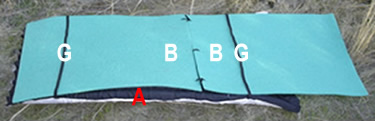
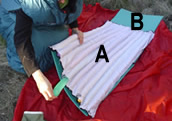
than one and only costs $15. This is it! The bottom
is an air mattress (A) comprised of party balloons
inside synthetic silk. This serves as the cushion.
The upper (the side you sleep on) is a closed cell
foam pad (B) which acts as additional cushion as
well as the insulation. |
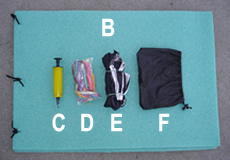 |
B
Coleman Rest Easy Pad cut to 20"x59"
then in half
C dollar store balloon pump
D 24 260Q party balloons (2 nights
+ spares)
E syn silk balloon encasement;
10 sleeves; 20"x48"
F sil-nylon stuff sack
Total weight = 10oz |
At camp, the balloons are
pumped up and slid in to their encasement (E)(process
shown in upper right pic). This completes
the air mattress (A). The two mats (B) are then
attached (see closed cell sleeping
pad modifications below) and slid under
the two air mattress elastic retention straps
(G).
The air mattress provides
the cushion where it's needed most:
shoulder to hips. My lower legs hang off the air
mattress but are sufficiently cushioned and insulated
with the foam pad (B). My head is supported by
a nature pillow (see photo at
bottom of page ).
Though there is not a sleeping
pad in production offering such a favorable comfort/weight
ratio, this system has a very high fiddle factor
taking about 10 minutes of effort to set up. And
while more durable than one would think, there
seems to be no quality control with these balloons.
Some will pop for no reason. Imagine a balloon
popping near your head at 3 am (during
testing, I averaged 1/night).
That aside, the good balloons (unfortunately,
there's no way to tell the good from the bad)
will bear my 150 pounds and active sleeping characteristics
fine...if the ground is prepared perfectly. In
that sense, using this mattress very much reminds
me of the following quote by Charles Lindsey:
"Bomb-proof is a solution for carelessness
while lightweight is a reward for carefulness".
Though this isn't a recommendation
on my part, if this mattress sounds like your
thing, it's not difficult to make. Just take a
4'x4' piece of synthetic silk, fold it over and
sew ten sleeves in it (I was experimenting
w/ different silks hence the black & white
colors). Then, sew two 3/8" wide elastic
straps (G) on and modify a closed cell foam pad
as outlined below. The balloons and pumps are
easy to find and you can carry it all in a quart
sized zip-lock or bread sack...or, you can make
your own. Making a stow bag like this is one of
the easiest sewing projects there is (though
sil-nylon is tricky to work with due to its slipperyness).
For tips on sewing, materials, etc, click here. |
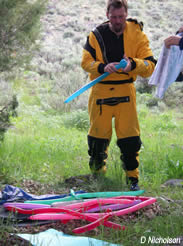 |
 |
| ....oh,
and the balloons serve as morning entertainment
for your buddies. |
| Closed
cell foam sleeping pad modifications |
|
|
Modifiying
a closed cell pad so that it's easier to pack
is simple: cut it in half. Insert
each half in to each dry bag then pack the rest
of your gear inside. The pad adds protection to
your gear whilst being crammed in the stern. If
the pad won't fit inside your drybags, put each
half anywhere in the boat...unrolled conforming
to the shape of your kayak (I have even used them
as extra thigh/knee cushion). The bluish colored
pad in the left photo is a
Coleman Rest Easy Pad used in my experimental
mattress above. The gray pad is a Gossamer Gear
Nightlight cut down to 19.5"x46".
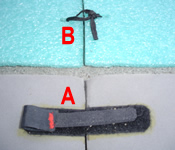
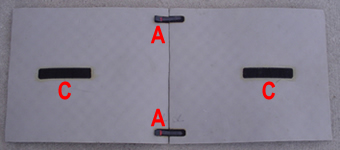
There are two
ways of reattaching the two halfs at camp:
(A) velcro which is attached to the foam with
adhesive or (B) tying/stiching with string. The
velcro is by far the more convenient and trouble-free
method. However, (B) makes for a faster mod and
can be reinforced with duct tape for extra longevity.
In the photo on the right, (C) is velcro that
attaches the pad to the underside of my bivy floor.
Sleeping pad & shelter floor protection in
one. Double duty! |
What about pillows?
There are several things you can do here besides taking
the special Winnie the Pooh "camp pillow":
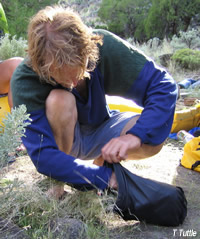 |
| Stuffing
grass in a sleeping bag stuff sack for a nature
pillow. |
- Place your spray skirt or wetsuit
inside the sleeping bag stuff sack then under your
shelter if they are damp. Your PFD can be used alone
or under your shelter as well. Remember though. If
these items contain too much moisture, whether under
your shelter or in a stuff sack, they'll feel cold
and rob heat from your body.
- Build up a mound of leaves, rush,
grass and/or moss under the shelter floor or place
it inside your sleeping bag stuff sack. The dried
grass is quieter than leaves and warmer than some
thing that's green. If you don't like the feeling
of nylon against your face, place the sack inside
extra clothing if it's available.
- Place rock/s of desired shape
and size under the head of the sleeping mat. Sounds
terrible but I'm finding myself doing it more frequently.
Try. You may like it too!
|