| The
word "scavenge" can conjure up images of crows pecking at
roadkill…or mumbling souls, food scraps hanging fore and aft,
waist deep in dumpsters. Those realities aside, here, "scavenge"
means to collect useful material by searching. This can be for philanthropical
reasons, true ecological building, or for the simple sake of saving
something useful from going to waste. Its purpose is as philosophical
as it is practical.
Rather than advocate full-time dirty dumpster rummaging, this page
serves to suggest observation and consideration of what is needlessly
wasted every day. Remember though. If you do choose to scavenge
something, don't be surprised if you find yourself wanting to do
it again. Once you get over the associated social stigma, it’s
actually quite fun and habit forming. Just remind youself
that the shame is in the practice of waste, not the act of scavenging.
Scavenging knows no socioeconomic
boundaries.
Dumpster Diving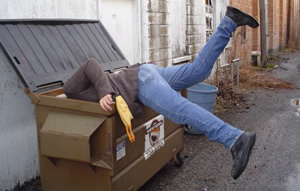
Below are a few tips to get you started. The
primary idea is to be stealth enough not to be seen or confronted.
If that happens often enough in the same place, the management may
take measures to keep you out and you’ll lose that resource.
- Laws vary. Check legality
in your area.
- If you ask a business, they’ll probably
say “no” due to liability concerns.
- If dumpster is next to a private residence,
ask the owners. They’ll probably
say “yes”.
- Always wear leather gloves, solid shoes and
drab clothing that won’t draw attention.
- Don’t dive if there are “No Trespassing”
signs.
- Don’t dive in the dark. You’ll
look suspicious.
- Choose a time of day with the least traffic.
Early weekend mornings are usually good.
- Do a quick scan of the area. If there are
people around, come back another time.
| Rummaging
not nesescary. I have pulled numerous items from
overflowing dumpsters by simply paying attention. Some of
the better things I have found include antique windows &
doors; new but slightly damaged tables & chairs; a heavy
duty handtruck; & two full suspension mountain bikes
one of which was brand new with only one missing petal. |
- Be quiet and discreet yet fast. Look in and
if there’s something appealing, waste no time. Get it and
move along. Deftness is key!
- Unless going for big items, working solo
is typically the quickest mode. It can be fun to have friends
along though.
- Take appropriate vehicle. It takes time to
tie things to a roof rack and draws attention.
- If asked what you are doing, politely say
something to this effect: “I’m looking for box’s.
Do you happen to have any or know where I could get some?”
- If asked to leave, be polite and oblige.
| |
|
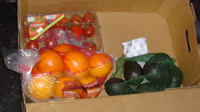
Found behind
a store in Idaho, these perfectly good Florida oranges &
California avocados & tomatoes had their final ride to the
landfill rerouted to a needy family’s dinner table. This
food, along with peppers, asparagus, cherries & butter was
in perfect condition but nearing its expiration date. From seed
to market to a landfill on the other side of the continent...all
while people struggle. Our society thinks nothing of this but
shames those saving this food. Something to ponder.... |
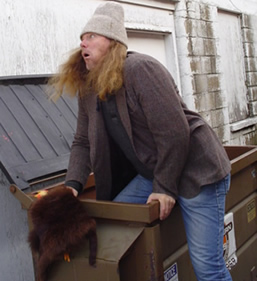
| "Whoa...looks
like it's my lucky day.........." -Mark Farmer |
Take responsibility.
If you get hurt, deal with it yourself. |
For additional information, visit
Ran Prieur's Dumpster
Diving FAQ.
Scrounging
Scrounging differs from dumpster diving in the
fact that the item in question has not been thrown away but rather
is laying in heaps amongst weeds or in other obvious locations which
indicate non-use. Learning to spot and acquire these items for free,
without coming across as a mooch, is a mix of art and psychology.
Once learned though, the scrounger will find many people are happy
to give. The giver sees it as a way to clean their place and help
someone at the same time. However, others are tight-fisted packrats
who'd rather watch something rot then part with it. Being able to
identify these mulish folks can save you from some uncomfortable
encounters. Squalid conditions should be your first clue.
What can be salvaged? Nearly
everything from entire homes slated for demolition to downed trees
for firewood. Also, many
fruit trees in rural (I'm seeing this in metropolitan
areas too) have been abandoned leaving the hardiest species
thriving naturally and without chemicals. Hundreds of bushels of
nourishing apricots and various other fruits go to waste every season
in my part of the state. Sadly, our society in general has reached
such a state of ignorance that it thinks nothing of the ramifications*
involved when purchasing fruit imported from other states and countries.
The overwhelming majority of this fruit is grown with polluting
agricultural practices too.
*Food
picked green (i.e. not yielding its full nutritional
value), air pollution (transport emissions),
depletion of fossil fuels (fuel, tires,
road maintenance & truck maintenance), etc, etc.
| With
as few as 3 hrs/mo & a continuous eye, I have salvaged up
to $6000/yr in building materials alone. Much of this has been
old growth fir lumber, 80 yr old solid wood doors & windows.
All this free for the taking. |
Where can it be found? Anywhere,
but older establishments and agricultural areas are the biggest
producers. More specifically:
- corners of fields and farm yards where materials
have been piled for burning
- old farm junkyards
- abandoned homes
- alleys
- vacant lots
- lots to be developed
- farm implement suppliers. Think about it.
A tractor axle can't be shipped in a cardboard box. It's delivered
in a wooden (often hardwood) crate that
is later discarded like Christmas wrapping paper. This wood can
be used for things from shelving to firewood. Steel, which is
used for the reinforcment of bigger crates, sees the same fate;
the landfill.
Additionally:
- Be on the constant look-out and take alternate
routes to and from work.
- Drive slower so you’re less apt to
miss something. You'll also save gas and be safer.
- Avoid places with excessive junkyness, fences,
“no tresspassing” signs or guard like dogs.
- Drive courteously with no loud music.
- Avoid looking like the stereotypical
"scrounge" and dress nicely. Your odds
of success will go up considerbly if you are are well groomed
and wearing clean attire. Casual office type dress is well recieved.
- When some thing of interest has been found,
find the owner by knocking on doors.
- take off sunglasses
- make eye contact
- be confident, not cocky
- smile with friendly enthusiasm
- hands in front
| Get
the word out! Tell friends, family, neighbors
& coworkers about your finds. Before you know it,
they'll be finding stuff for you. And some will even
start scavenging for themselves.
Enthusiasm begets enthusiasm!
|
- When owner is found, concisely explain that
you were passing by and "happened
to notice ____" and ask if there are plans for it. I've
had a few owners ask me if I wanted whatever it was I was interested
in before I even had to ask! If not so lucky, and they tell you
it’s going to be burned or hauled to the dump, ask if you
can salvage it. And use the term "salvage"
rather than "have".
- If the owner says “no”, do not
press. Graciously accept and leave.
- If the owner says “yes”, be extra
appreciative and if possible, get the item then. If you can not
pick up then, ask when you can and describe the vehicle you’ll
be driving so they know what to expect (people can get jumpy when
an unfamiliar vehicle pulls in to their place, particularly rural
folks not used to seeing a lot of traffic). Retrieve ASAP and
be punctual.
Also, check out The
Freecycle Network, a grassroots movement giving away nearly
any thing imaginable. World wide, this diverse group has over 3,000
communities and 1.9 million members. Membership is free.
|